Right next to you, in a bed of their own.
Which bedside crib should you choose in 2026? Our criteria (fit with your bed, height, attachment, mattress, age and weight), the rules of safe sleep, our setup advice and our reference model, the Maxi-Cosi Iora: a crib that attaches to your bed, from birth to 6 months.
- 2-in-1Bedside or standalone
- 0-6 monthsUp to 9 kg
- 5Heights
- 18.5 cmFolded in its bag
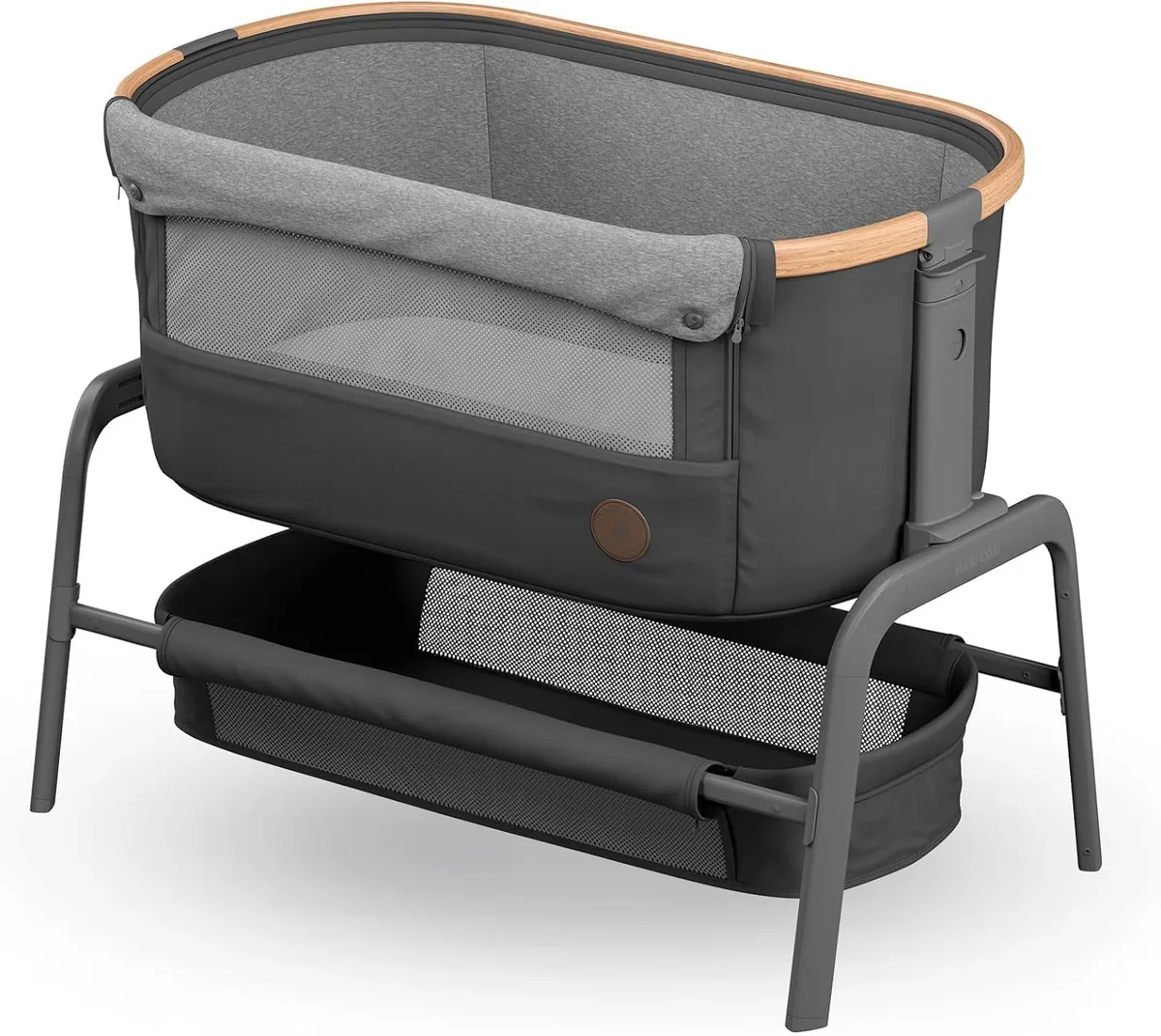
- 2-in-1 bedside crib
- From birth
- Up to 9 kg
- 5 heights
- Sliding system
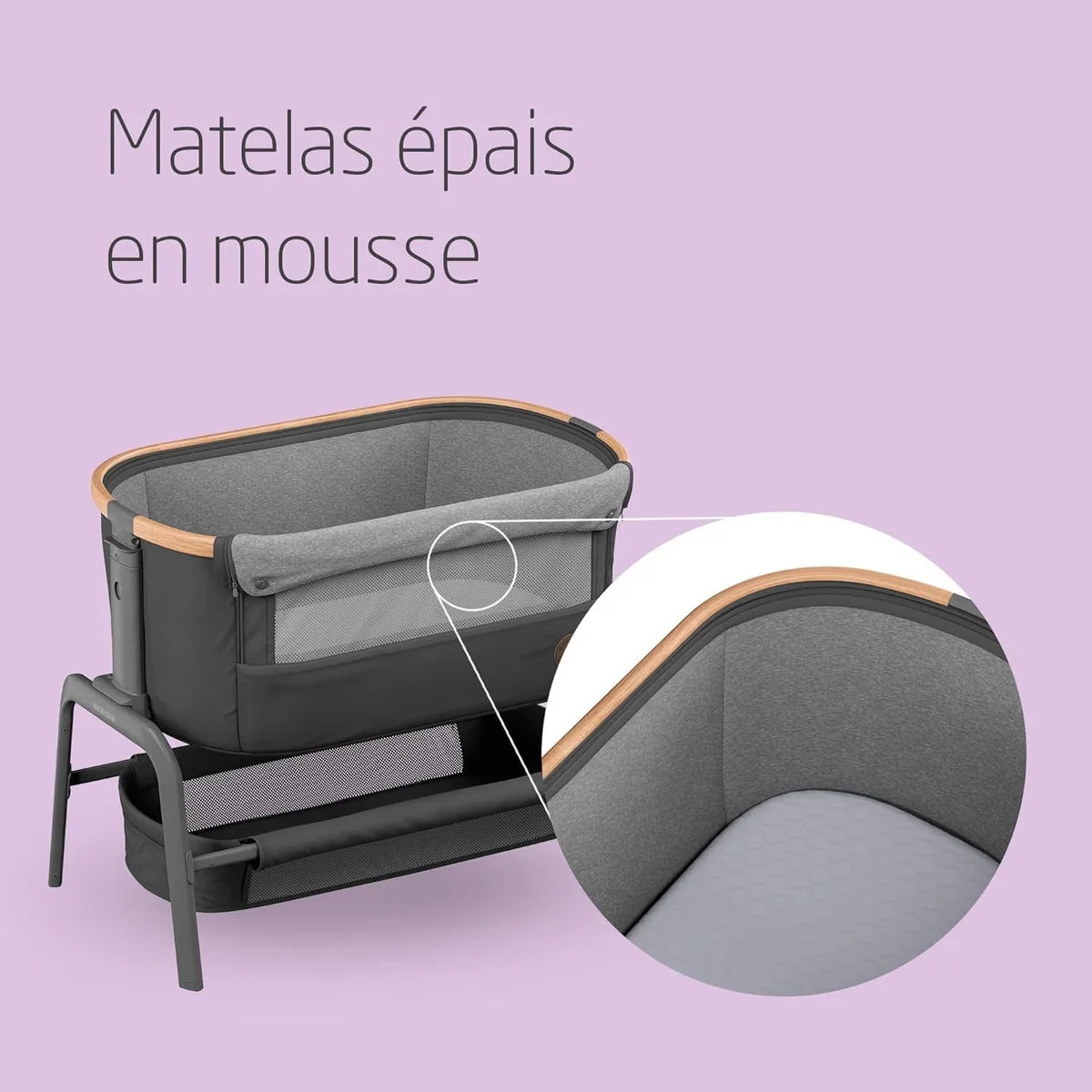
- Padded mattress
- Mesh window
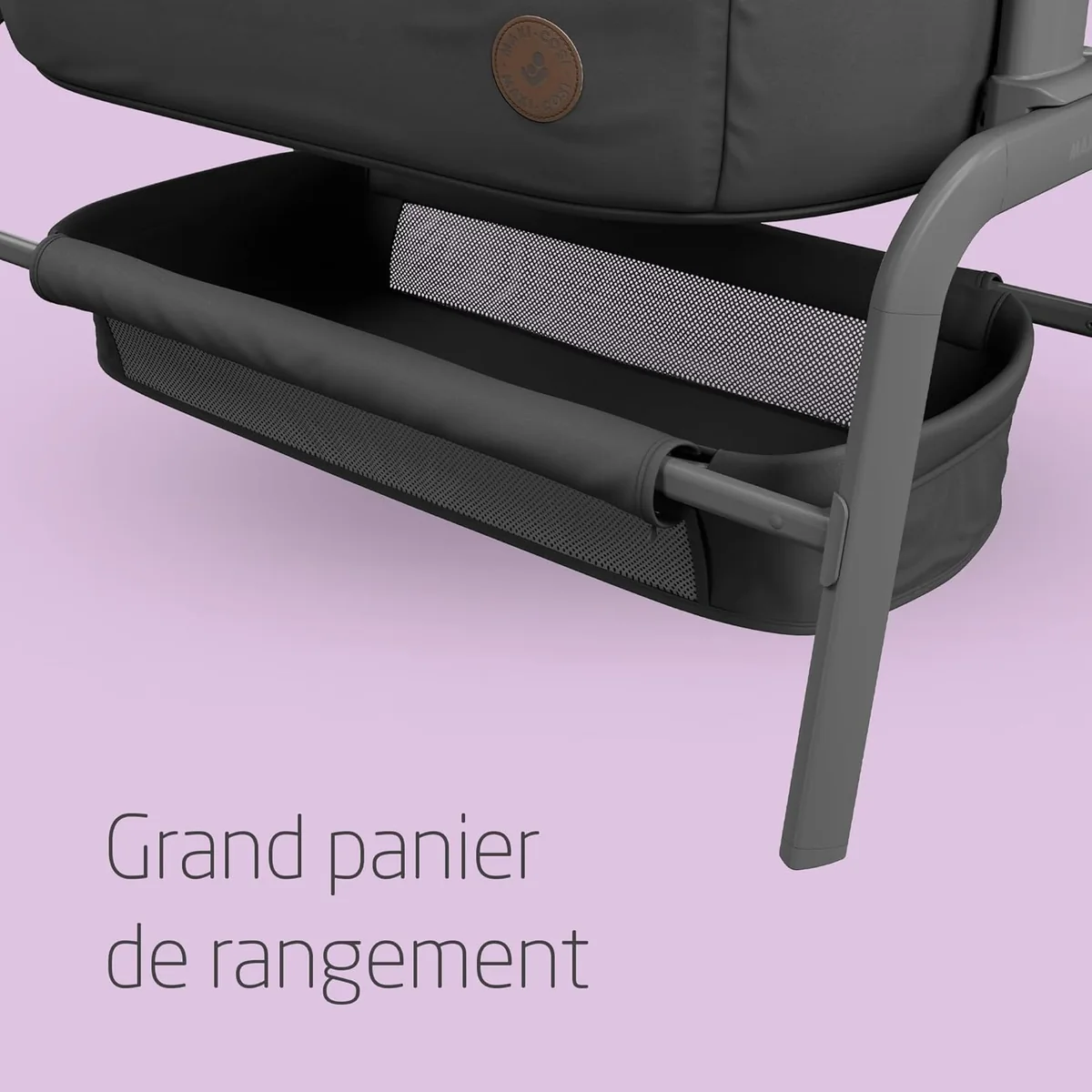
- Large basket
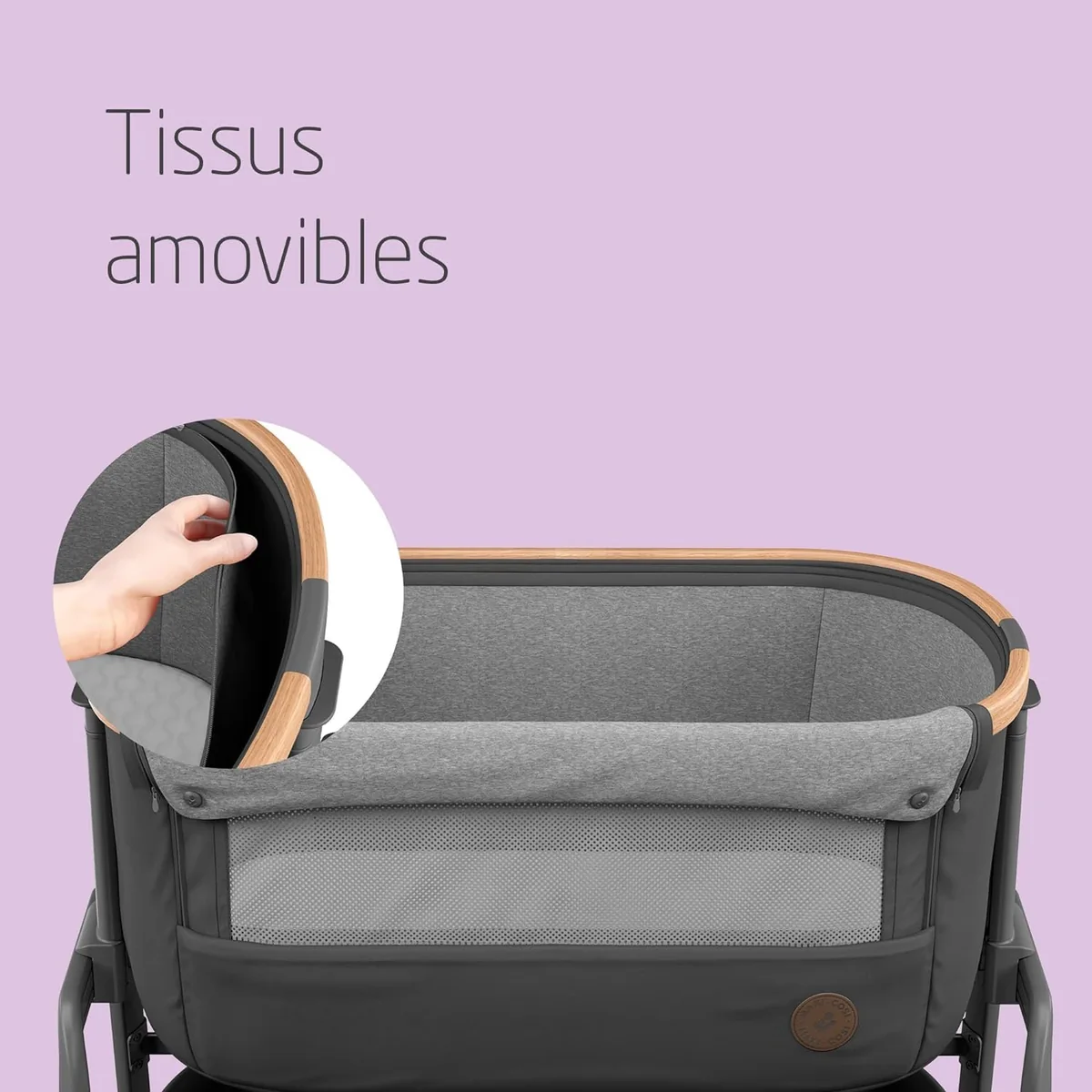
- Removable fabrics
- Travel bag
The bedside crib that adapts to your bed and your nights.
The strengths of the Maxi-Cosi Iora. Select one to see it in pictures.
- 2-in-1Bedside or crib
- 9 kgBaby’s max weight
- 0-6Months of use
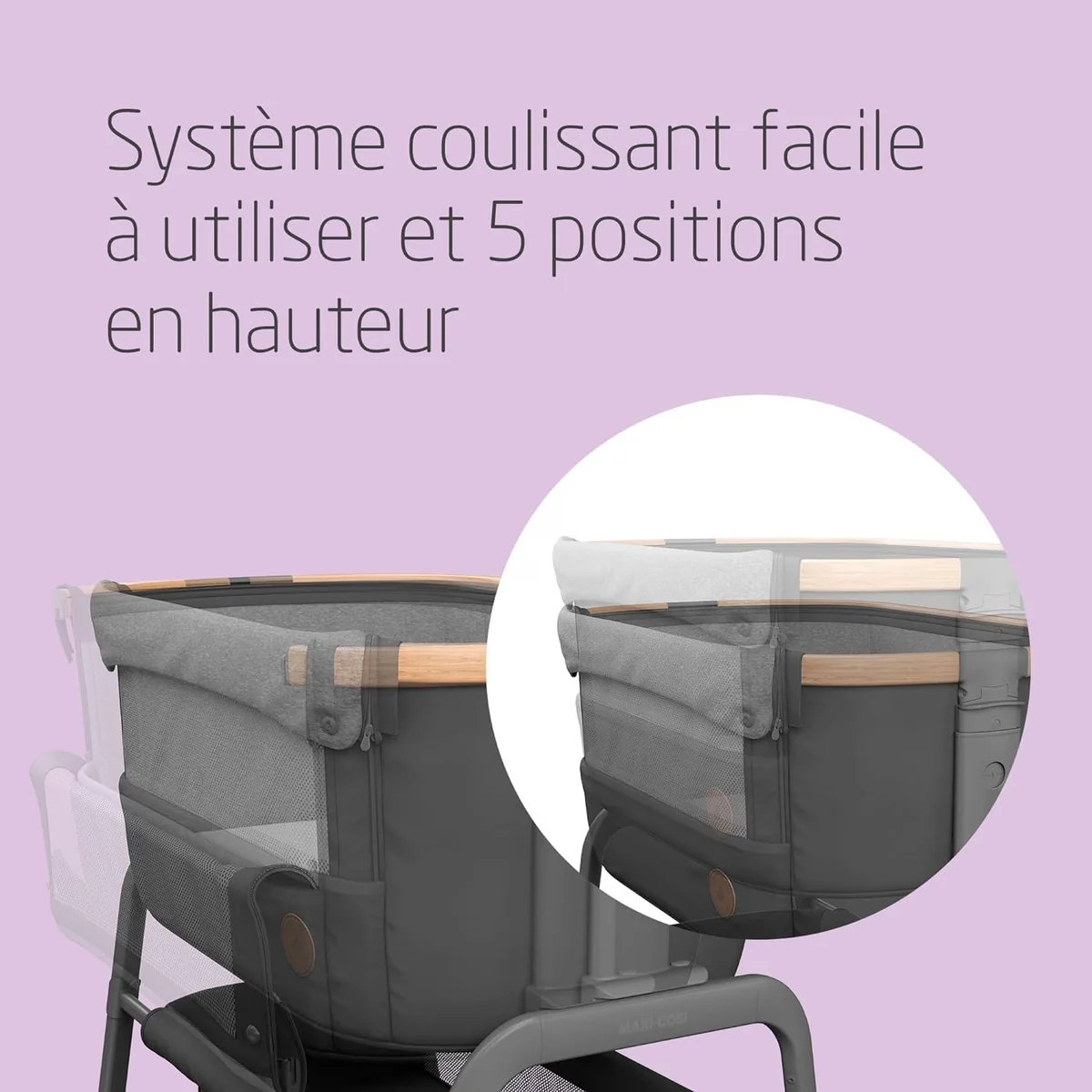
- 5Height positions
- 4Incline positions
- 18.5 cmThickness in its bag
Check your bed before you buy.
- 56 cmMin. bed height (frame + mattress)
- 30 to 49 cmBed frame height
- ≤ 5.5 cmGap between frame edge and mattress
- 74.5 to 85.5Iora height (cm)
- 10.8 kgCrib weight
- 107 x 56 x 18.5Folded in its bag (cm)
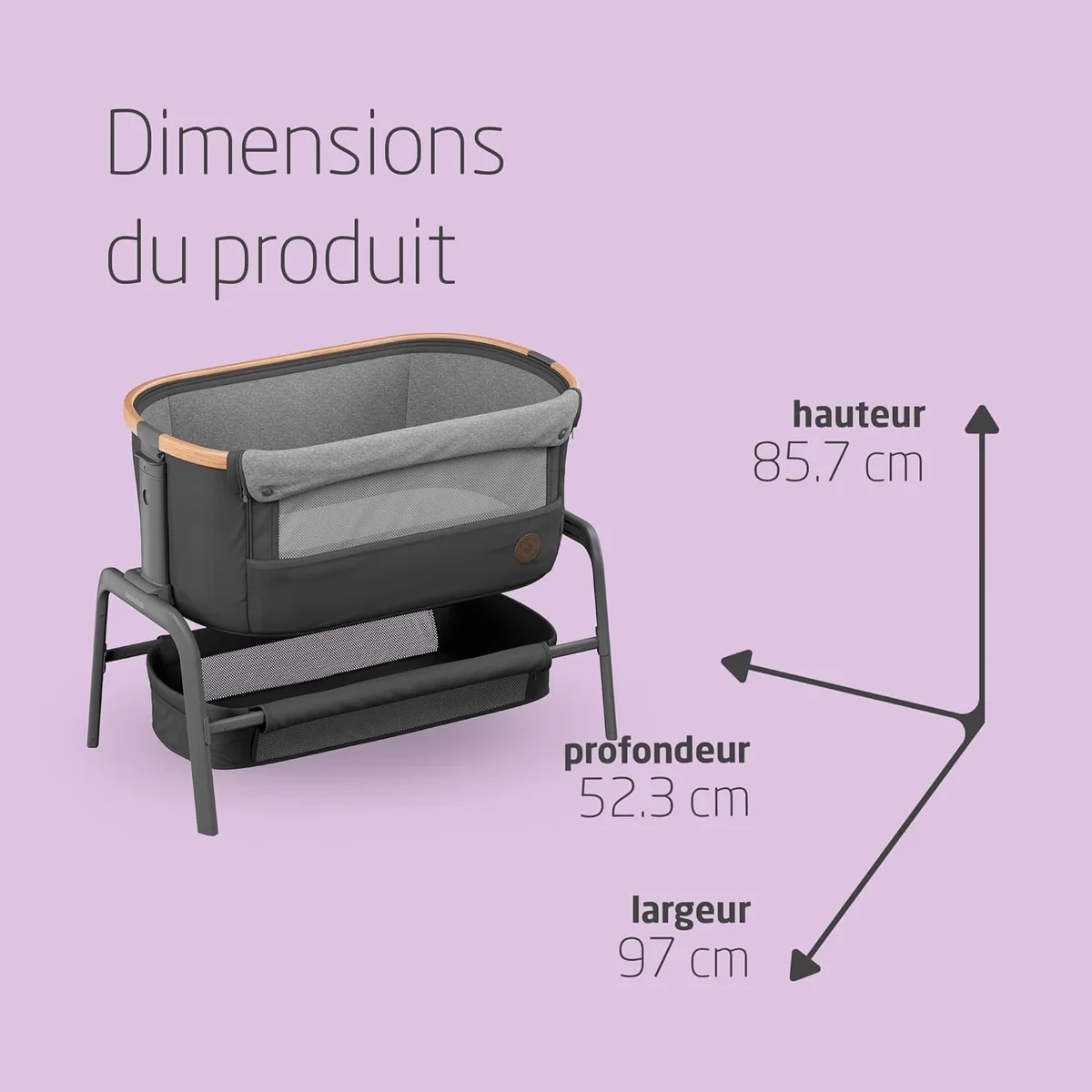
The three compatibility conditions come from Maxi-Cosi’s warning. Heights, weight and folded dimensions come from the Maxi-Cosi listing and from retailers (Boots, John Lewis, Bambinou). Some visuals show slightly different measurements (97 x 52.3 cm, 85.7 cm) that belong to other versions of the Iora range. Test your bed with our compatibility calculator.
Guide contents
Comparison: the right sleeping space for you
There is no single ideal sleeping space for the first months, only families who expect different things from it. Some want to keep their baby within arm’s reach for night feeds without bringing them into their own bed. Others have a small bedroom and need a compact crib. Others again prefer to invest straight away in a cot that will last three years. Before comparing models, you need to know which group you are in, and take a look at your own bed.
| Your situation | What you need | The point to watch |
|---|---|---|
| Breastfeeding and frequent waking at night | A bedside crib that attaches to the parents’ bed, side down | Fit with your bed and no gap between the two sleeping surfaces |
| Small parents’ bedroom | A bedside crib or compact crib placed along the bed | The width available and room to move around at night |
| One purchase for three years | A cot with bars, possibly placed in your bedroom | The space it takes up in the parents’ room |
| Daytime naps in the living room | A 2-in-1 bedside crib that can be used as a standalone crib | The weight of the crib if you move it often |
| Regular nights at the grandparents’ | A folding bedside crib with travel bag, or a travel cot | Whether it fits their bed, which may not be the same as yours |
The bedside crib we feature, the Maxi-Cosi Iora, ticks the first two rows and the fourth. It does not suit every bed, and we say so clearly below. If you are still hesitating between a bedside crib, a standard crib and a cot, our article bedside crib, Moses basket or cot explains the differences.
What is a bedside crib?
“Co-sleeping” covers two practices that are often confused. Bed sharing means having the baby sleep in the parents’ bed. Room sharing means putting the baby in the parents’ room, but in their own sleeping space. The bedside crib, also called a next-to-me crib, side-sleeper or co-sleeping crib, belongs to the second family: it is a crib with one side that lowers and that attaches to the parents’ bed, at the same height as their mattress.
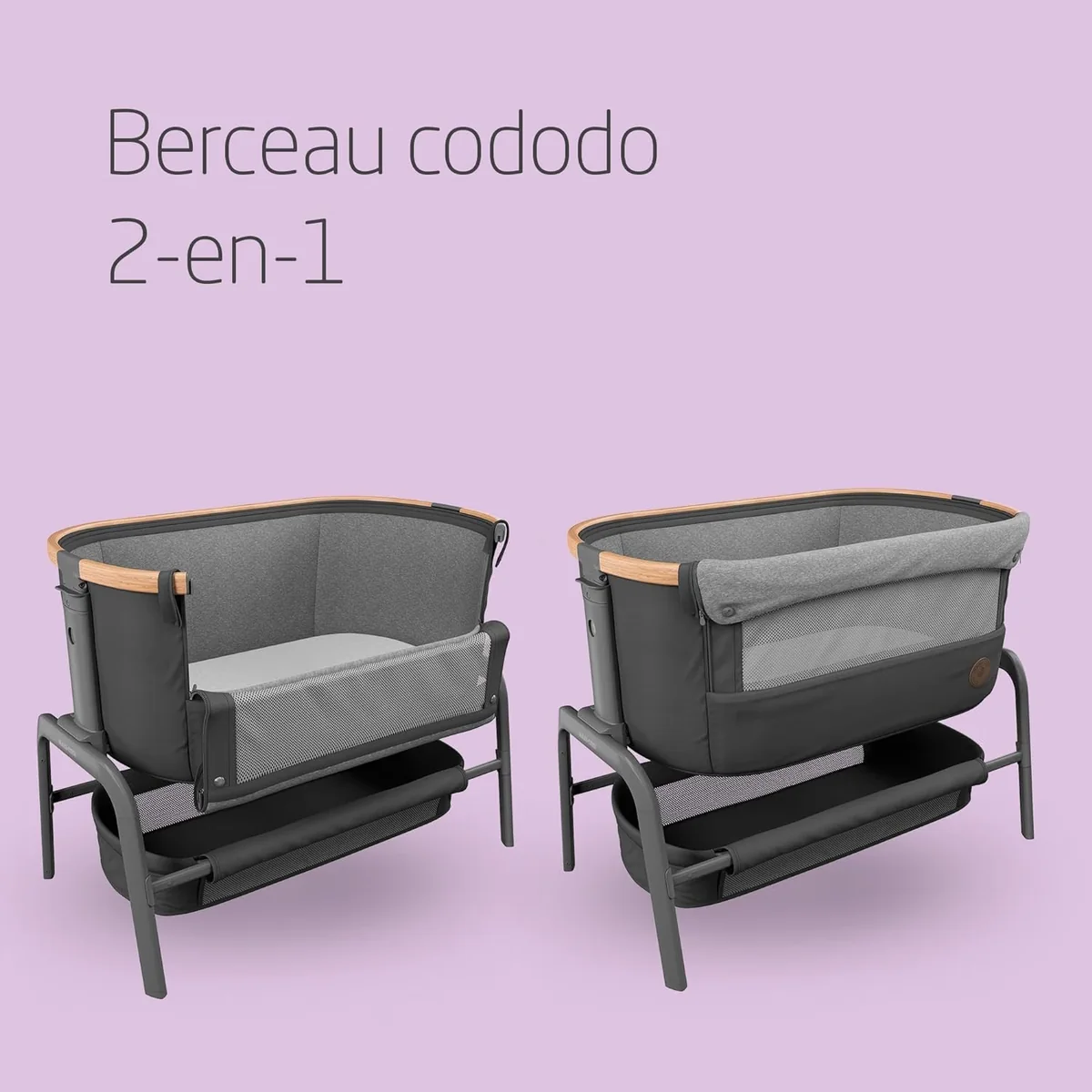
In practice, your baby sleeps in their own space, on their own mattress, but a few centimetres from you. At night, you can see them, hear them, rest a hand on them or pick them up for a feed without getting up. When you want to move them further away, or for daytime naps in the living room, most models turn into a standard crib: you raise the side and the crib becomes freestanding.
A bedside crib differs from an ordinary crib in three ways: a side that lowers, height adjustment to line up with the parents’ mattress, and a system to stay attached to the bed (a base that slides under the bed frame, attachment straps, or both). These three features are exactly the ones that need the most attention when buying and setting up.
Our pick: the Maxi-Cosi Iora
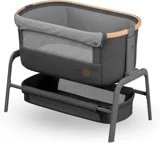
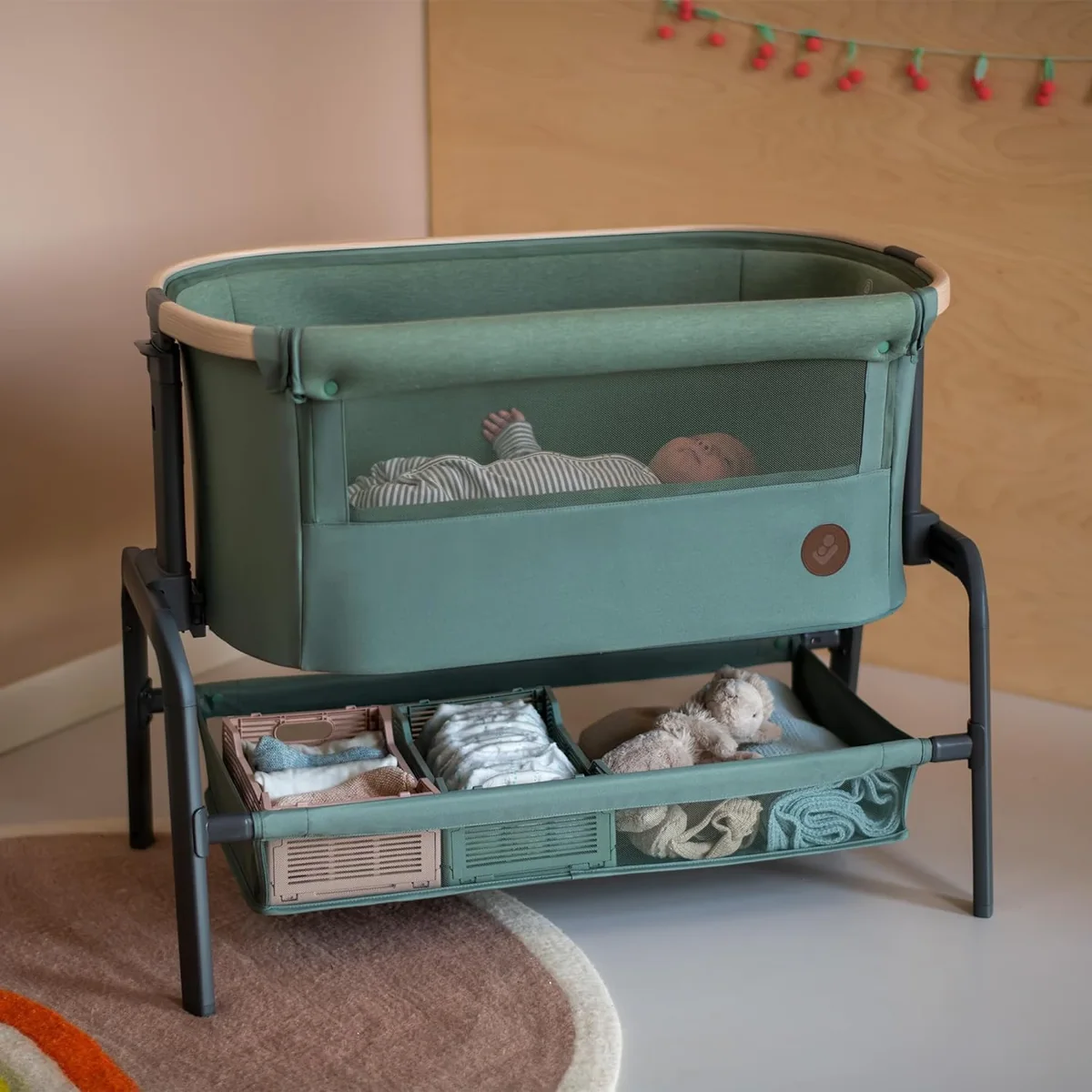
The Maxi-Cosi Iora is a 2-in-1 bedside crib: with the side down, it attaches to your bed; with the side up, it becomes a standalone crib. Maxi-Cosi announces it from birth to about 6 months, up to 9 kg. It adjusts to five heights, its base slides under the parents’ bed, its padded mattress can be inclined to four positions, a large mesh window lets you see your baby and a large basket sits under the sleeping area. It folds into a travel bag supplied.
According to Maxi-Cosi’s listing and retailers, it weighs 10.8 kg, measures about 93 x 55 cm when open, with an adjustable height of 74.5 to 85.5 cm, and folds into a bag of 107 x 56 x 18.5 cm. Maxi-Cosi states compliance with EN 1130, the standard for cribs and bedside cribs, and a standard 24-month warranty, extended to 5 years if you register the product online within 6 months of purchase.
Its limitations are just as clear. It does not fit every bed: Maxi-Cosi requires a total height of at least 56 cm (frame and mattress included), a bed frame 30 to 49 cm high, and a gap between the edge of the frame and the mattress of no more than 5.5 cm. This version has no wheels, which several parents regret. And its period of use is short, as with all bedside cribs. Our detailed verdict explains who it is made for.
Room sharing: what health authorities say
The position of the French health authorities is clear on one point: before 6 months, room sharing is protective. The French public health website sante.fr states that studies show sharing a room with the baby is a protective factor against sudden infant death, and that the crib can be placed against the parents’ bed for the first months. That is exactly what a bedside crib does.
The same site recalls the basic rule for any sleeping space: to prevent the risk of sudden unexpected infant death and support healthy motor development, a baby should always be put to sleep flat on their back, on a firm mattress. The leaflets of the US National Institutes of Health say the same: a flat, level sleep surface covered only by a fitted sheet, and sharing the room but not the bed.
Not all authorities agree about the bedside crib itself. Health Canada considers that “co-sleeper” products intended to be attached to an adult bed are not safe, because of a risk of entrapment, and recommends a standalone crib or cot placed in the room. In Europe, these products are covered by EN 1130, the standard for cribs that includes bedside cribs. This disagreement shows one thing: a bedside crib is only safe if it is perfectly set up, with no gap between the two sleeping surfaces, on a compatible bed. That is the thread running through this whole guide, and through our article on bedside crib safety.
Key point: the recommended form of co-sleeping is the same room, not the same bed. A bedside crib is a way of sharing the room while keeping your baby very close, provided its setup conditions are respected.
Fit with your bed
This is the criterion that product listings highlight least, and the one that causes the most disappointment. A bedside crib must attach to the parents’ bed without leaving any gap the baby could slip into, and its sleeping surface must sit at the right height relative to the parents’ mattress. To achieve this, each model sets its own conditions. For the Iora, Maxi-Cosi sets three:
- A total height of at least 56 cm. Measure from the floor to the top of the parents’ mattress, frame and mattress included.
- A bed frame of 30 to 49 cm. Measure from the floor to the top edge of the frame, without the mattress. The Iora’s base must be able to slide underneath and the lowered side must reach the right level.
- A gap of no more than 5.5 cm between the edge of the frame and the mattress. Beyond that, Maxi-Cosi says not to use the bedside crib.
These three measurements take five minutes with a tape measure. Take them before you buy, not on the day you set it up. Our compatibility calculator checks your three measurements, as well as your baby’s age and weight.
Some beds often cause problems: ottoman or storage beds, whose frame goes down to the floor and stops the base from sliding underneath; very low beds, such as futons or Japanese-style beds; beds with a very thick frame or a high edge; mattresses placed on a base with no frame. Our article will a bedside crib fit my bed? goes through each case and the possible solutions.
The 10 criteria of a good bedside crib
- Fit with your bed: total height, frame height, gap to the mattress, presence of storage drawers or an ottoman base.
- Height adjustment: number of positions and range covered, to line up your baby’s sleeping surface with your mattress.
- The attachment system: a base that slides under the bed, attachment straps, or both.
- The drop-down side: how easy it is to lower and raise, and a firm lock in the raised position.
- The mattress: firm, flat, fitted to the crib, with fitted sheets of the right size easy to find.
- Age and weight limits: often 6 months and 9 kg, or as soon as the baby rolls over or sits up.
- Visibility and ventilation: breathable mesh to see your baby, even with the side up.
- Use as a crib: useful for naps in the living room or if you want to move your baby away from your bed.
- Storage and care: basket, removable fabrics, machine-washable cover.
- Folding and transport: bag supplied, weight, folded size, for nights at the grandparents’.
Our guide how to choose a bedside crib details each criterion, with questions to ask the seller and the traps in product listings.
Height, sliding and attachment
A bedside crib has to do two things at once: sit at the right height, and stay attached to your bed all night. For height, manufacturers’ general rule is to line up the baby’s sleeping surface with the top of the parents’ mattress, following each model’s instructions. The Iora offers five positions, from 74.5 to 85.5 cm according to a specialist retailer, in steps of about 2.75 cm.
To hold it in place, the Iora relies on a base that slides under the frame of the parents’ bed: the crib moves forward until it touches the mattress, with no gap between the two, and it does not rest at an angle. The Meilleurtest comparison also mentions straps to attach it to the parents’ bed. Whatever the solution, the test is the same: once set up, the bedside crib must not move away from your bed when you push on it. If it moves, the setup is not right.
Our article how to set up and attach a bedside crib details the steps, from the tape measure to the final test, with the most common mistakes.
The mattress and sheets
The mattress of a bedside crib is designed for that specific crib: it fits snugly into the base, with no gap at the sides. Safe sleep guidance calls for a firm mattress that fits the frame perfectly, covered with a well-fitted sheet, and nothing else. Maxi-Cosi highlights the comfort of the Iora’s padded mattress, and parents’ feedback describes it as comfortable. Comfortable must not mean soft: the mattress remains a firm surface your baby does not sink into.
Never add a second mattress, a mattress topper, a folded duvet or a cushion. For sheets, choose fitted sheets that exactly match the size of the mattress. Maxi-Cosi sells cotton Iora sheets in packs of two, compatible with the Iora, Iora Air and Tori according to retailers. A sheet that is too big creates folds; a badly fitted sheet can come loose. Our how-to guide explains how to fit the sheet and remove the fabrics.
Incline: flat by default
The Iora, like other bedside cribs in the range, lets you incline the sleeping surface to several positions. Maxi-Cosi presents them as a way to minimise reflux. This argument appeals to many parents of newborns, and it deserves to be put in context.
Safe sleep guidance is consistent: babies sleep flat on their back. Sante.fr says so for the prevention of sudden unexpected infant death, and the US leaflets specify that a safe sleep surface is flat and level, not inclined. Our position is therefore simple: use the flat position by default, and only set an incline on the advice of your paediatrician or doctor, strictly following the instructions. Infant reflux is common and often harmless, but it is for a doctor to judge, not a product listing. Our article bedside crib incline and reflux goes into this in detail.
How long does a bedside crib last?
Less long than you might think. The Iora is announced from birth to about 6 months, up to 9 kg. The EN 1130 standard covers cribs for infants until they can sit up unaided, stand up or get onto their hands and knees. For another model in the same range, Maxi-Cosi specifies moving to a bigger bed as soon as the baby can sit up, roll over or push themselves up unaided.
In practice, the first limit reached is the one that counts: 9 kg, 6 months, or the first time your baby rolls over, sits up or kneels. Many babies reach one of these stages between 4 and 6 months. So plan the next step when you buy: a cot with bars, which you can also put in your bedroom if you want to continue room sharing. Our article moving from a bedside crib to a cot helps you organise this step.
Check the price on AmazonMaxi-Cosi Iora bedside crib · new tabPutting your baby to sleep safely
A well-installed bedside crib does not replace the basic rules of infant sleep. They are the same as in any crib:
- your baby sleeps on their back, flat, at night and for naps;
- on a firm mattress, the one supplied with the crib, with a well-fitted sheet;
- in a sleeping bag suited to their size, instead of any blanket;
- nothing else in the crib: no pillow, duvet, bumper or soft toy;
- in a room that is neither too warm nor too cold, and smoke-free.
The bedside crib adds its own rules. Your baby sleeps in their crib, not in the parents’ bed: after a feed, you put them back in their own space. No duvet or parental pillow should spill over towards the crib. And if you have drunk alcohol, taken medication that makes you drowsy, or are so exhausted that you might fall asleep holding your baby, raise the side of the crib: closeness must not become a risk. Our guide bedside crib safety covers all these rules.

What a bedside crib changes at night
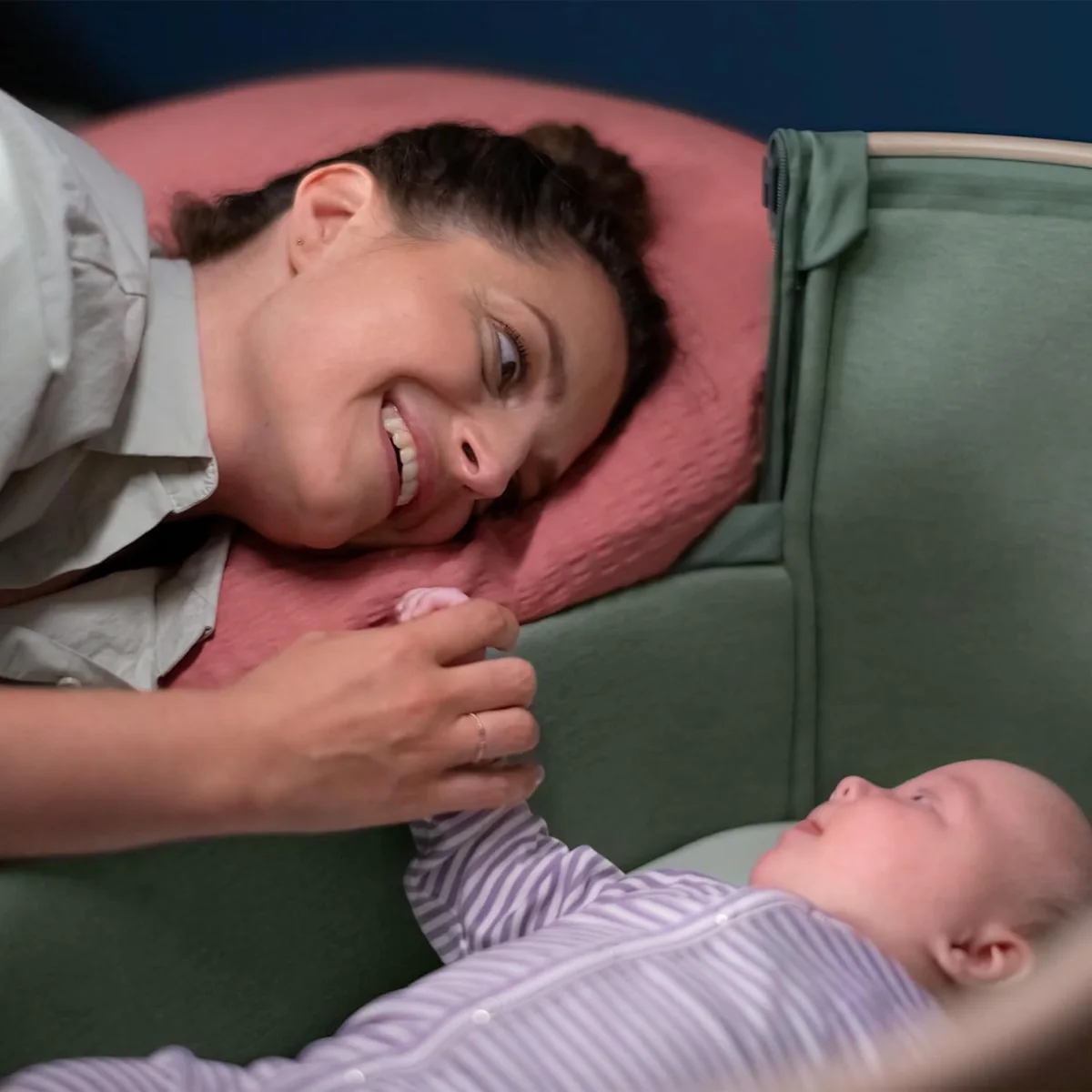
Parents rarely choose a bedside crib to save space. They choose it for the nights. In the first weeks, a newborn often wakes to feed. With a crib on the other side of the room, every waking means getting up, crossing the room, picking up your baby and sitting down. With a bedside crib, side down, your baby is within arm’s reach: you can soothe them with one hand, or pick them up for a feed and put them back without leaving your bed.
For breastfeeding mothers, or after a caesarean, saving these movements matters a great deal. It does for the other parent too: the night is less broken up. A bedside crib does not make your baby sleep longer, and it does not replace a rhythm that settles in gradually. It simply makes wakings shorter and gentler. Our articles bedside cribs and baby sleep and bedside cribs and night feeds describe these nights in detail.
Care, storage and travel
A crib gets its share of spit-up and leaking nappies. On the Iora, Maxi-Cosi states that the inner fabrics of the crib and basket unzip and can be machine washed, following the care label, and that the frame can be wiped with a damp cloth. The large basket under the sleeping area holds nappies, bodysuits, sleeping bag and a spare fitted sheet, which keeps your bedside table clear.
Folded, the Iora fits into its travel bag, 18.5 cm thick. It can go to the grandparents’ or on holiday, on one condition: check that the bed it will go against is compatible, using the same three measurements as at home. Otherwise, use it as a standalone crib, side up, next to the bed. Our how-to guide covers folding, removing the fabrics and washing.
Standards and labels to check
In Europe, the reference standard is EN 1130:2019, “Furniture, cribs and cradles for domestic use, safety requirements and test methods”. It applies to cribs, including rocking and swinging cribs and bedside cribs, for infants until they can sit up unaided, stand up or get onto their hands and knees. It covers materials, construction, the base, the sides, stability, packaging, instructions for use and marking. Another standard, EN 16890, covers mattresses for cots and cribs.
When buying, also check that there are instructions in your language with the warnings, the manufacturer’s or importer’s details, the model reference and the age and weight limits. Be wary of a bedside crib sold without instructions in your language, or whose listing says nothing about compatibility with the parents’ bed.
Mistakes to avoid
- Buying without measuring your bed, then discovering the base will not slide under an ottoman bed.
- Leaving a gap, even a small one, between the bedside crib and the parents’ mattress.
- Setting the baby’s sleeping surface lower or higher than the parents’ mattress, against the instructions.
- Adding a mattress, cushion or bumper to “make it cosier”.
- Letting the parents’ duvet or pillow spill over towards the crib.
- Using the incline all the time without medical advice.
- Continuing with the bedside crib when your baby rolls over, sits up or weighs more than 9 kg.
- Keeping your baby in the parents’ bed after a feed, instead of putting them back in their crib.
Who it suits, and who it does not
The Iora suits you if
- You want your baby within reach for night feeds
- Your bed meets Maxi-Cosi’s three conditions
- You want a 2-in-1 crib for naps in the living room
- You like having a storage basket under the sleeping area
- You want to be able to take it to the grandparents’
It suits you less if
- Your bed is an ottoman bed or a very low bed
- You want to move the crib often from room to room (no wheels)
- You are looking for a sleeping space that lasts more than six months
- You are counting on the incline for every night
- You prefer a single purchase up to age 3
Buying on Amazon: what to check
The Iora range has several versions that look alike: Iora, Iora Air (with wheels and a rocking function), Iora Plus, Iora Pro, Iora². They do not weigh the same, do not have the same dimensions and do not always have the same features. Before ordering, check the exact model name and colour (Essential Graphite for ours), the seller, the box contents (bedside crib, mattress, travel bag) and that instructions in your language are included. The price changes often: we do not show it, we link to the current offer.
Remember the sheets too: they are sold separately. And keep your proof of purchase, which you will need for your statutory rights and for the warranty extension announced by Maxi-Cosi if you register online.
Our editorial method
We are not a test laboratory and we did not receive the Iora from the brand. Our information comes from the manufacturer’s listing, its compatibility warning, specialist retailers’ listings, the EN 1130 standard and the safe sleep guidance published by health authorities. When we summarise parents’ feedback, we describe the recurring trends, without naming anyone or copying reviews. Our rating is an editorial assessment, not a customer review. More details on our affiliate disclosure page.
Frequently asked questions
What is the best bedside crib?
The one that fits your bed. Among the models we studied, the Maxi-Cosi Iora is our pick for its sliding system, five heights, mattress and basket, provided your bed meets its conditions.
Is a bedside crib safe?
It allows room sharing, which sante.fr describes as protective before 6 months, provided it is compliant, set up with no gap to the parents’ bed and used according to safe sleep rules: baby on their back, flat, nothing in the crib.
Up to what age can you use a bedside crib?
Up to about 6 months and 9 kg for the Iora, or earlier as soon as your baby rolls over, sits up or pushes up unaided.
Does the Maxi-Cosi Iora fit every bed?
No. Maxi-Cosi requires a total height of at least 56 cm, a frame of 30 to 49 cm and a gap of no more than 5.5 cm between the frame and the mattress.
Can the Iora be used as a standard crib?
Yes, with the side up it becomes a standalone crib, for example for naps in the living room.
Should you use the anti-reflux incline?
Guidance recommends a flat sleeping surface. We advise the flat position by default and an incline only on medical advice.
Does the Iora have wheels?
Not this version. Wheels come on other models in the range, such as the Iora Air.
Are sheets included?
No. Maxi-Cosi sells cotton Iora fitted sheets in packs of two. Always choose sheets that exactly match the size of the mattress.
At night, at nap time, at the weekend.
The moments when a bedside crib really changes the first nights, and those when it becomes a simple crib.
Technical specifications.
- UsesBedside crib (side down) and standalone crib (side up)
- Suitable forFrom birth to about 6 months, up to 9 kg
- Crib weight10.8 kg
- Open93 x 55 cm, height 74.5 to 85.5 cm
- Folded in its bag107 x 56 x 18.5 cm
- Settings5 heights, 4 incline positions, sliding system
- Compatible parents’ bedTotal height ≥ 56 cm, frame 30 to 49 cm, gap ≤ 5.5 cm
- CareRemovable inner fabrics, machine washable
- StandardEN 1130 (cribs, including bedside cribs)
Maxi-Cosi data (Iora listing and warning) and retailer listings for the dimensions. Details and sources in our full specifications.
Maxi-Cosi Iora bedside crib
- Fitting against the bed★★★★★
- Sleeping comfort★★★★★
- Adjustments★★★★★
- Storage and practicality★★★★★
- Transport★★★★★
- Value for money★★★★★
The Maxi-Cosi Iora is aimed at parents who want to keep their baby within arm’s reach at night, in a bed of their own, for the first six months.
It is not made for every bed: a base that is too low, a frame that is too thick or a storage bed can stop it from sitting properly against yours. Our detailed verdict explains who it is for, and who it is not for.
Why it is our top pick
- A true 2-in-1: a bedside crib against your bed with the side down, a standalone crib with the side up.
- A sliding system and five heights to line up your baby’s mattress with yours.
- A padded mattress that Maxi-Cosi highlights and that parents describe as comfortable.
- A large storage basket under the sleeping area, much appreciated for nappies and night-time bodysuits.
- A mesh window to see your baby even with the side up, and removable inner fabrics.
- It folds into a travel bag supplied, for nights at the grandparents’.
Limitations
- It does not suit every bed: total height of at least 56 cm, frame of 30 to 49 cm, gap between frame edge and mattress of no more than 5.5 cm. Measure before you buy.
- A short period of use: from birth to about 6 months, or 9 kg, or as soon as the baby rolls over or sits up.
- No wheels on this version: several parents regret having to carry it to move it.
- The four incline positions are promoted against reflux, while health guidance recommends a flat sleeping surface: we advise staying flat unless a doctor says otherwise.
Our guides to go further.
Choosing, setting up, sleeping safely: our detailed articles.
Does the Iora suit your baby?
A quick check against the limits announced by Maxi-Cosi: from birth to 6 months, up to 9 kg.
Bedside crib with the side down, standalone crib with the side up, from birth to 6 months, with five heights, a sliding system, a large basket and a travel bag.
- 0-6 months
- 9 kg max
- 5 heights
Ready for those first nights?
2-in-1 bedside crib · 0 to 6 months · Up to 9 kg · Travel bag. Prices and colours change often on Amazon: check them, along with the seller, the exact model (Iora, Iora Air, Iora Plus…) and whether it fits your bed, before ordering.
Check the price on AmazonAffiliate link · new tab