Bedside cribs and baby sleep: getting through the nights
A bedside crib does not make your baby sleep longer. It changes the way you experience their wakings. Here is how to make the most of it, night after night, while keeping the sleeping space safe.
Contents
What a bedside crib changes, and what it does not
Many parents buy a bedside crib hoping for better nights. Let us be honest: a bedside crib does not make your baby sleep longer, and it does not stop wakings. A newborn wakes to feed several times a night, whatever their sleeping space. What a bedside crib changes is the way you experience those wakings.
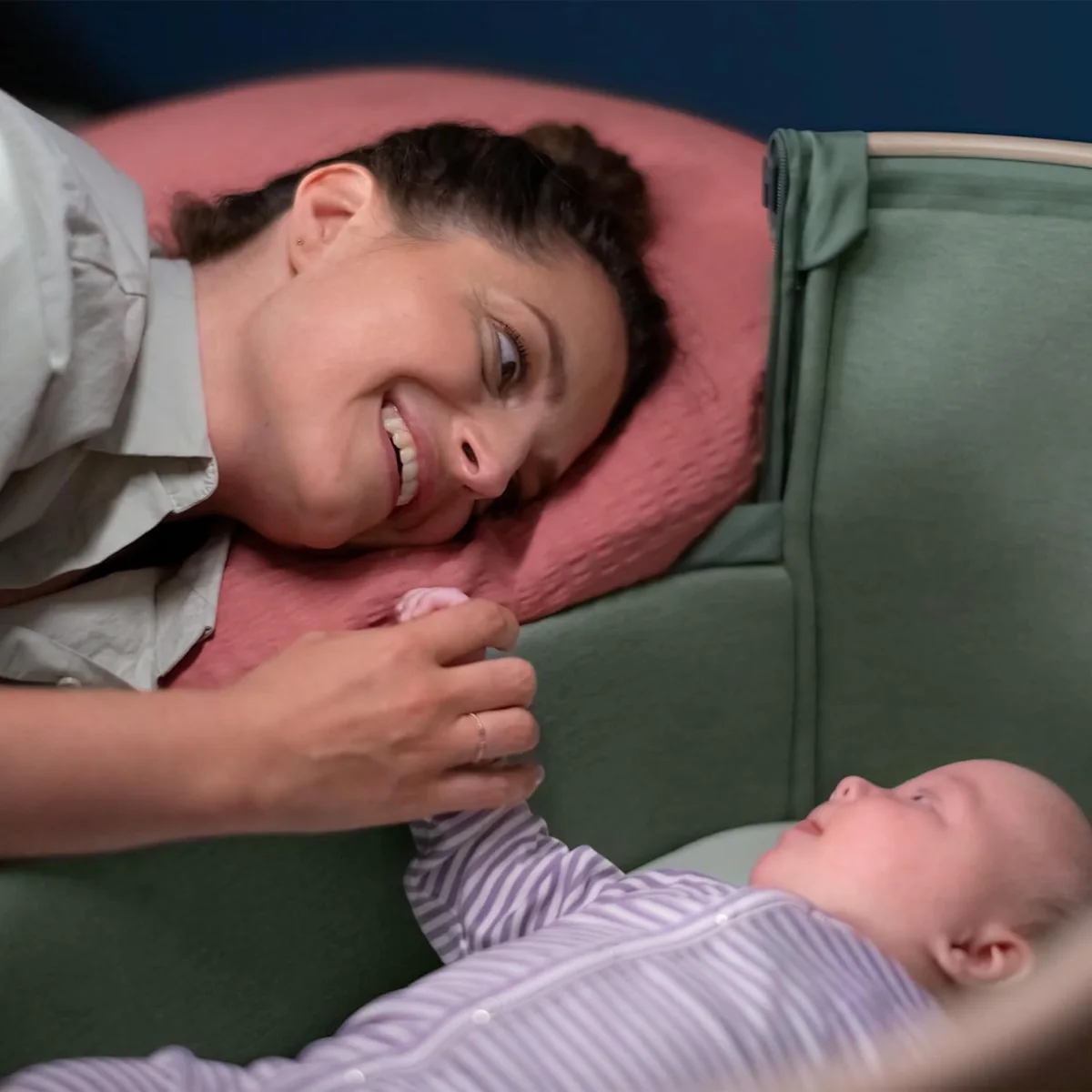
With a crib across the room, every waking follows the same scenario: you hear your baby, get up, cross the room, pick them up, settle down to feed them, then put them back and return to bed. With a bedside crib, side down, your baby is within arm’s reach. You see them without turning on the light, you can rest a hand on them to reassure them, pick them up for a feed while staying lying or sitting in your bed, and put them back in their sleeping space without getting up. Each waking is shorter, calmer, and you fall back to sleep faster.
A bedside crib also reassures many parents. Hearing your baby breathe, seeing them a few centimetres away, knowing they are there: for some, that is what finally lets them sleep. And it follows the health authorities’ recommendation that room sharing before 6 months is protective, provided the baby sleeps in their own sleeping space.
How newborns sleep
A newborn does not sleep like an adult. They sleep a lot, but in short periods spread over day and night. They do not yet tell day from night: this distinction develops gradually over the weeks. Their sleep cycles are shorter than ours, and they spend more time in active sleep, during which they move, grimace and make little noises, without being awake.
This last point matters with a bedside crib. Because your baby is so close, you hear them more. A small grunt, a sigh or a movement does not always mean they are awake or need you. Learn to wait a few moments before stepping in: often they drift back into calmer sleep on their own. A bedside crib lets you watch without disturbing them.
Every baby has their own rhythm. Some sleep longer stretches from the first weeks, others wake often for months. There is no norm to reach, and comparing your baby with others rarely helps. If you have doubts about your baby’s sleep or feeding, talk to your midwife, health visitor or doctor.

The basis: a safe sleeping space
Before routines and tips comes the sleeping space. The rules are the same for every night and every nap:
- your baby is put down on their back, flat;
- on the firm mattress supplied with the crib, with a well-fitted sheet;
- in a sleeping bag suited to their size, with no blanket;
- with nothing else in the crib: no pillow, duvet, bumper, soft toy or wedge;
- in a smoke-free room that is neither too warm nor too cold.
The bedside crib adds its own rules. It must fit your bed and be set up with no gap between the two sleeping surfaces. Your duvet and pillows must never spill over towards the crib. And your baby sleeps in their crib, not in your bed. For the Maxi-Cosi Iora, which has an incline, we advise the flat position by default: guidance calls for sleeping flat on the back, and the incline is for medical advice only. All the details are in our guide bedside crib safety.
Preparing the bedroom
The parents’ bedroom also becomes the baby’s for a few months. A few adjustments make nights easier for everyone.
Temperature
A room that is too warm is not good for your baby’s sleep. Common recommendations in France suggest a temperate room, around 18 to 20 °C. Adapt the sleeping bag to the season rather than adding layers of clothing. To check whether your baby is too warm, feel the back of their neck or their back, not their hands, which are often cool.
Light
The bedside crib lets you see your baby without turning on the light. Use a soft night light, placed so it does not shine directly on their face. It helps you check they are fine, change and feed them without waking everyone. During the day, on the other hand, let natural light in: it helps your baby tell day from night.
Noise
There is no need for absolute silence. Your baby gets used to the ordinary noises of the house. At night, speak softly and avoid bright screens and phone ringtones.
Organisation
The basket under the Iora’s sleeping area is designed for this: nappies, wipes, a spare bodysuit and fitted sheet, a backup sleeping bag. Prepare it every evening. On your bedside table, keep a glass of water, a nursing pillow if you use one, and your phone on silent. Anything that saves you getting up counts.

The bedtime routine
A routine is a series of simple actions, always in the same order, that signal sleep. It does not guarantee your baby will fall asleep, but over the weeks it helps them associate these actions with sleep. It does not need to be long: a few minutes is enough.
- Nappy change and pyjamas, in soft light.
- The sleeping bag, always the same one for the night.
- The breastfeed or bottle, calmly.
- A cuddle, a song, a few soft words.
- Putting your baby down in the crib, on their back.
With a bedside crib, you can stay next to your baby while they fall asleep, your hand near them, without bringing them into your bed. The same routine can later be used in the cot, which will make the transition easier.
Night wakings
When your baby wakes, start by watching. Is it a real waking, with rising cries and signs of hunger, or a moment of active sleep? The bedside crib lets you see without moving. If your baby is hungry, feed them. If they are just restless, a hand on them and a soft voice are sometimes enough.
Signs of hunger are often visible before crying: your baby turns their head, opens their mouth, brings their hands to their mouth, wriggles. Spotting them early stops them from waking fully. With a bedside crib, you see them more easily. For breastfeeding at night, our article bedside cribs and night feeds details positions and organisation.
If your baby needs changing, do it in soft light, with calm movements and few words. The aim is for them to get back to sleep quickly. Save long conversations and play for the daytime.
Putting your baby back in the crib
This is the most important moment of bedside crib nights. After a feed, your baby often falls asleep against you. It is very tempting to keep them there, in your bed, and drift off too. That is exactly what a bedside crib helps you avoid: your baby is put back a few centimetres away, in their own sleeping space, without you having to get up.
Get into the habit of putting them down as soon as the feed ends, on their back, in the middle of their mattress, away from the edge of your bed. Check that your duvet and pillow do not spill over. If you feel yourself falling asleep during the feed, put your baby down before giving in to sleep. If you are very tired, or have taken medication that makes you drowsy or drunk alcohol, raise the side of the crib for the night.
Telling day from night
A newborn does not yet have a day and night rhythm. You can help them build it gradually. During the day, let natural light in, talk to them, play with them while they are awake, do not try to keep silent during naps. At night, keep a soft light, calm movements and few words. This contrast, repeated day after day, helps your baby understand that night is for sleeping.
Daytime naps
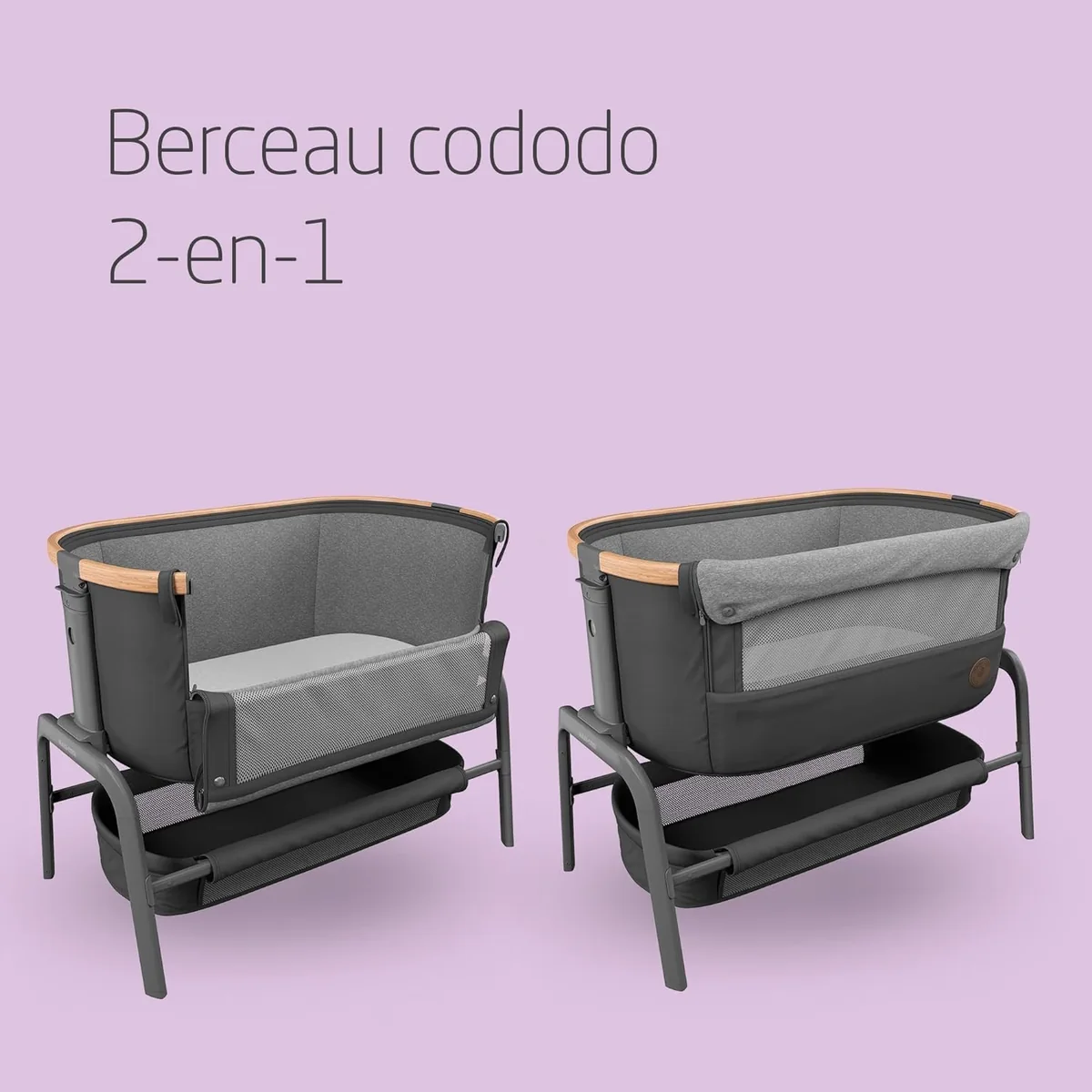
A 2-in-1 bedside crib like the Iora can also be used for naps. With the side up and properly locked, it becomes a standalone crib that you can set up in the living room or your bedroom. The Iora has no wheels: to move it, you have to lift it, and it weighs 10.8 kg. Some families leave it in the bedroom and use another sleeping space in the living room.
The sleeping rules are the same for naps as for the night: on the back, flat, nothing in the crib. Never let your baby sleep on a sofa, a nursing pillow or a bouncer not designed for sleep.
The other parent
The bedside crib is often set up on the breastfeeding parent’s side. Yet the other parent has a full role to play at night. They can take care of nappy changes, burping, putting the baby back down, wakings not related to hunger, or handle the first waking of the night while the other parent sleeps. If your baby is bottle-fed, parents can take turns by night or by waking, possibly moving the crib from one side of the bed to the other, provided that side is also compatible.
The other parent can also organise the bedroom: prepare the basket and check every week that the bedside crib is still firmly against the bed, that the height has not changed and that the mesh is intact. These are simple tasks that matter a lot.
Parental tiredness
The first months are exhausting. A bedside crib lightens the nights, but does not remove them. A few principles help you keep going:
- sleep when your baby sleeps, at least once during the day if you can;
- accept help from family and friends with shopping, meals and laundry;
- share nights with the other parent as soon as possible;
- lower your expectations for the house;
- tell your midwife, health visitor or doctor about your tiredness if it becomes too heavy.
Extreme tiredness is also a risk factor at night, because it makes falling asleep with your baby in your arms more likely. If you feel you cannot cope, raise the side of the crib, ask the other parent to take over, and look for support. Baby blues and postnatal depression exist and can be treated: talking about it is a first step.
With an older sibling at home
An older child may be curious about the crib, want to put a soft toy in it, climb on it or play with the drop-down side. Explain simply that the crib is the baby’s bed and nothing should be added to it. Do not leave a young child alone near the crib. And never let an older child sleep in the parents’ bed on the bedside crib side, where they could slide towards the baby’s sleeping space.
Nights change: month after month
Over the weeks, nights change. Sleep periods often get longer, wakings become less frequent and the day and night rhythm settles in. It is never linear: there are more restless nights, growth spurts, colds and teething. The bedside crib is there for the months when wakings are most frequent.
Then your baby grows. As soon as they roll over, sit up or push themselves up unaided, or reach the bedside crib’s weight limit, 9 kg for the Iora, it is time to move to a bigger bed. This often happens between 4 and 6 months. Our article moving from a bedside crib to a cot helps you prepare this step gently.
Check the price on AmazonMaxi-Cosi Iora bedside crib · new tabMistakes to avoid
- Keeping your baby in your bed after a feed, instead of putting them back in their crib.
- Adding a blanket, cushion or soft toy “so they are comfortable”.
- Using the incline every night without medical advice.
- Dressing your baby too warmly or overheating the room.
- Letting your duvet slide towards the crib.
- Stepping in at every noise when your baby is only in active sleep.
- Continuing with the bedside crib when your baby rolls over or sits up.
- Neglecting regular checks of the setup.
When to ask for advice
Talk to your doctor, midwife or health visitor without delay if your baby seems to have difficulty breathing, refuses to feed, has a fever, is unusually floppy or hard to wake, spits up a lot or seems to be in pain after feeds. In an emergency, call the emergency services (999 or 112 in the UK). Also ask for advice if your nights become unbearable: there are professionals trained to support young children’s sleep and parents’ tiredness.
Week by week: what to expect
The first days
Your baby sleeps most of the day and night, in short periods broken up by breastfeeds or bottles. They make no difference between day and night. You are getting to know them, and they are learning to feed. The bedside crib lets you recover between wakings without getting up every time.
The first weeks
Awake periods get a little longer and your baby starts looking around. Night feeds are still frequent. Some babies have restless periods in the evening, which often worry parents but are common. This is a good time to gradually introduce the contrast between day and night, and a little bedtime routine.
The second and third months
The day and night rhythm often begins to show. A longer stretch of sleep sometimes appears early in the night. Wakings remain frequent for many babies, which is normal. You know their signs of hunger and tiredness better, and nights with the bedside crib become smoother.
The fourth month and beyond
Your baby becomes more alert and curious, and their motor development speeds up. Sleep may go through a more restless phase. This is also the age when many babies start rolling over, which marks the end of the bedside crib. Watch for these signs and prepare the move to a cot.
Evening crying
Many newborns cry more at the end of the day, for no obvious reason. This crying exhausts parents, especially since it often comes just before the night. A few things can help: a calm, dimly lit environment, carrying your baby against you, a soft voice, gentle rocking. If the crying is very intense, lasts a long time or comes with other signs, talk to your doctor. And if you feel you are losing your patience, put your baby down safely in the crib, on their back, and step away for a few minutes to breathe. Never shake a baby.
Dummies and comforters
If your baby uses a dummy, they can take it to fall asleep in their crib. Never attach it with a cord or a dummy clip during sleep. If it falls out once your baby is asleep, there is no need to put it back. If you are breastfeeding, your midwife can advise you on when to introduce it. As for a comforter, it has no place in a young baby’s crib: guidance calls for a sleeping space with no soft objects. It can come later, in the cot, following your doctor’s advice.
Winter and summer
In winter, resist the urge to overheat the room or add blankets. A warmer sleeping bag, suited to the season and your baby’s size, is enough. Keep the room temperate and air it every day. In summer, when it is hot, dress your baby more lightly, in a light sleeping bag or a simple bodysuit depending on the temperature, and do not let the sun shine directly on the crib. A fan must never blow directly at your baby, and its cable must stay out of reach. Feel the back of your baby’s neck to check they are neither too hot nor too cold.
When your baby is unwell
A cold, a fever or a blocked nose disrupt sleep. The bedside crib lets you watch your baby closely without bringing them into your bed. The sleeping rules do not change: on the back, flat, nothing in the crib. Do not raise the mattress or slide in a cushion to help breathing, unless your doctor specifically advises it. See a doctor if your baby has a fever, has difficulty breathing, refuses to drink or worries you. In a baby under 3 months, any fever calls for prompt medical advice.
Sleeping away from home
A weekend at the grandparents’, a holiday: the setting of the nights changes. Babies often sleep better when they find their familiar cues. Take their usual sleeping bag, keep the same routine and, if possible, their own sleeping space. The Iora folds into its bag and goes in the car. Check that the host bed is compatible, or use the Iora as a standalone crib, side up. Never put your baby to sleep in an adult bed, even for one night, for lack of anything better.
The couple and the bedside crib
Sharing the room with your baby also changes life as a couple. Some parents experience this closeness as natural, others need to get back a space of their own. Talk about it together, without guilt. The bedside crib is a solution for a few months, not an obligation. If one of you sleeps badly because of the baby’s noises, they can sleep elsewhere for a few nights to recover, while the other takes over. What matters is that everyone finds a balance.
Myths about sleeping with a bedside crib
“With a bedside crib, the baby picks up bad habits”
The closeness of the first months meets the needs of a newborn who wakes often to feed and to be reassured. A bedside crib does not stop them sleeping in their own bed later. What helps the transition is stable routines and a safe sleeping space that your baby finds again in their cot.
“A baby needs complete silence to sleep”
No. Babies get used to the ordinary noises of the house. At night, it is enough to speak softly and avoid sudden noises.
“A baby who sleeps a lot during the day will sleep less at night”
Not in a newborn. They need a lot of sleep, spread over the day. The day and night rhythm develops gradually, largely thanks to daylight and the contrast between day and night.
“You need to dress a baby warmly at night”
No. A temperate room and a sleeping bag suited to the season are enough. Being too hot is a risk factor.
The evening checklist
- The bedside crib is against the bed with no gap: push test done this week.
- The sleeping surface is flat, with the fitted sheet taut.
- Nothing in the crib apart from your baby in their sleeping bag.
- The basket is ready: nappies, wipes, bodysuit, spare sheet.
- The night light is in place and the room is temperate.
- The parents’ duvet and pillows are back from the edge.
- The other parent knows who gets up for what tonight.
When the other parent puts the baby down
Some babies fall asleep more easily with the parent who is not breastfeeding, because the smell of milk does not stimulate them. The other parent can take on the evening bedtime, with the same routine: nappy, pyjamas, sleeping bag, cuddle, song, putting the baby down in the crib on their back. They can also handle wakings not related to hunger, placing a hand on the baby or rocking them gently before putting them back down. These moments build a bond and give the breastfeeding parent a break.
Keeping a night log
In the first weeks, nights blur together. Many parents find it useful to keep a simple log, on paper or in a phone note: time of each feed, nappy changes, how long it took to settle, anything unusual. It is not about tracking performance, but about seeing patterns: a longer stretch beginning to appear, a time of evening when your baby is often restless, a night that went better after a particular routine. These notes are also precious during appointments with your midwife or doctor, who will ask about feeds and sleep. Keep it light: a few words per waking are enough, and if logging stresses you, stop. With a bedside crib, the notebook and a pen can live in the basket, ready for the night.
The essentials for calm nights
A bedside crib makes nights simpler without transforming them. It keeps your baby within reach, in their own sleeping space, flat on their back. Routines, daylight, a temperate room and teamwork do the rest. Put your baby back in their crib after every feed, check the setup regularly, and prepare the next step as soon as your baby approaches the limits.
The Iora and your nights
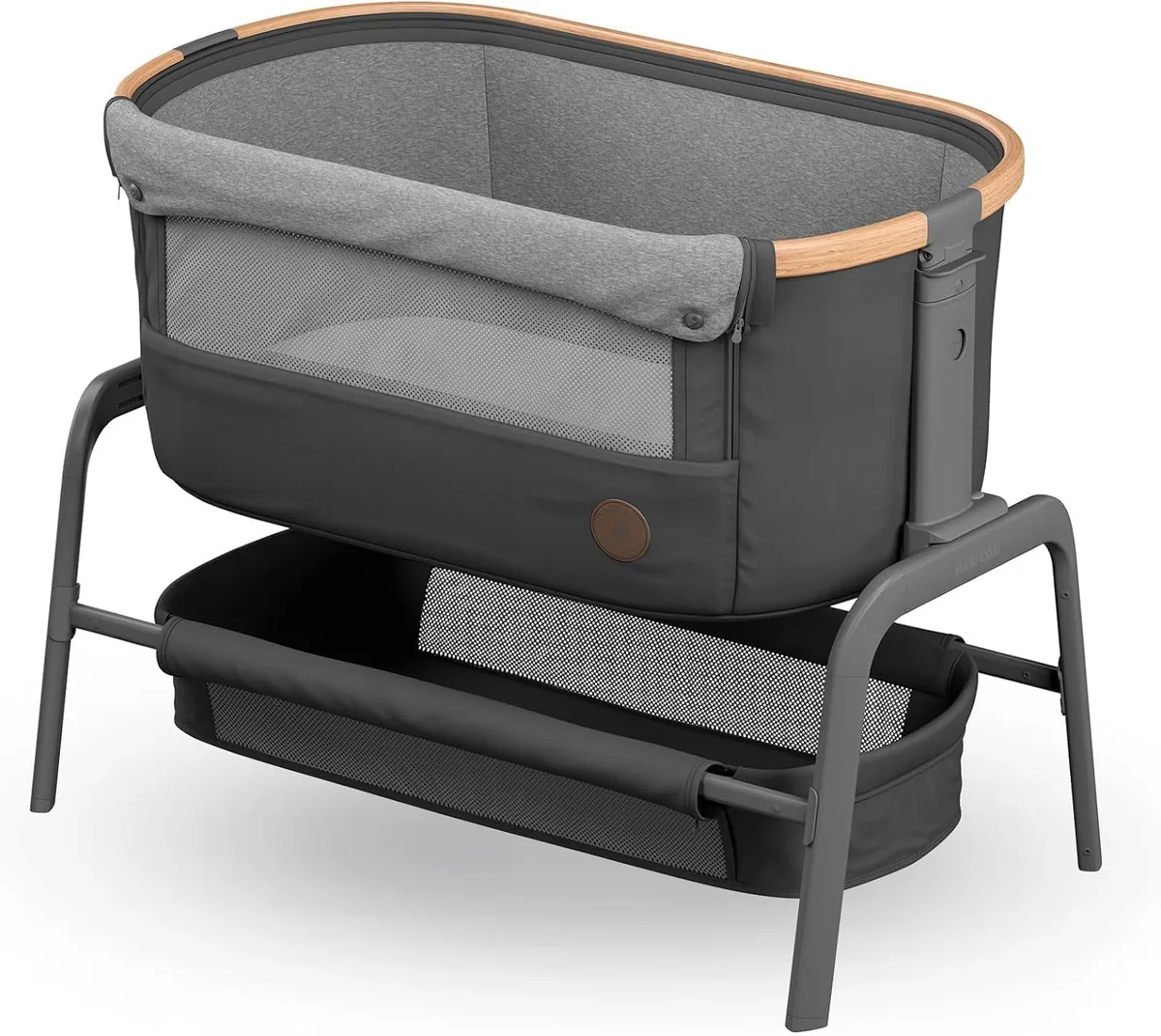
On the Maxi-Cosi Iora, several details make nights easier: the lowered side that puts your baby within arm’s reach, the large mesh window that lets you see them with the side up, the basket under the sleeping area for night-time changes, and removable fabrics for little accidents. The sleeping surface itself stays flat by default. Our review details each of these points.
Frequently asked questions
Does a bedside crib help babies sleep better?
It does not make them sleep longer, but it makes wakings shorter and calmer for the whole family.
Do you need a routine from birth?
It is not compulsory, but a few actions repeated in the same order gradually help your baby associate this moment with sleep.
What temperature should the room be?
A temperate room, around 18 to 20 °C according to common recommendations, with a suitable sleeping bag.
Can you use the bedside crib for naps?
Yes, with the side up and locked, as a standalone crib, with the same sleeping rules.
My baby makes noise all night: is that normal?
Newborns have active sleep, with noises and movements. Watch before stepping in, and talk to a professional if in doubt.
The articles in this section
Ready for those first nights?
2-in-1 bedside crib · 0 to 6 months · Up to 9 kg · Travel bag. Prices and colours change often on Amazon: check them, along with the seller, the exact model (Iora, Iora Air, Iora Plus…) and whether it fits your bed, before ordering.
Check the price on AmazonAffiliate link · new tab