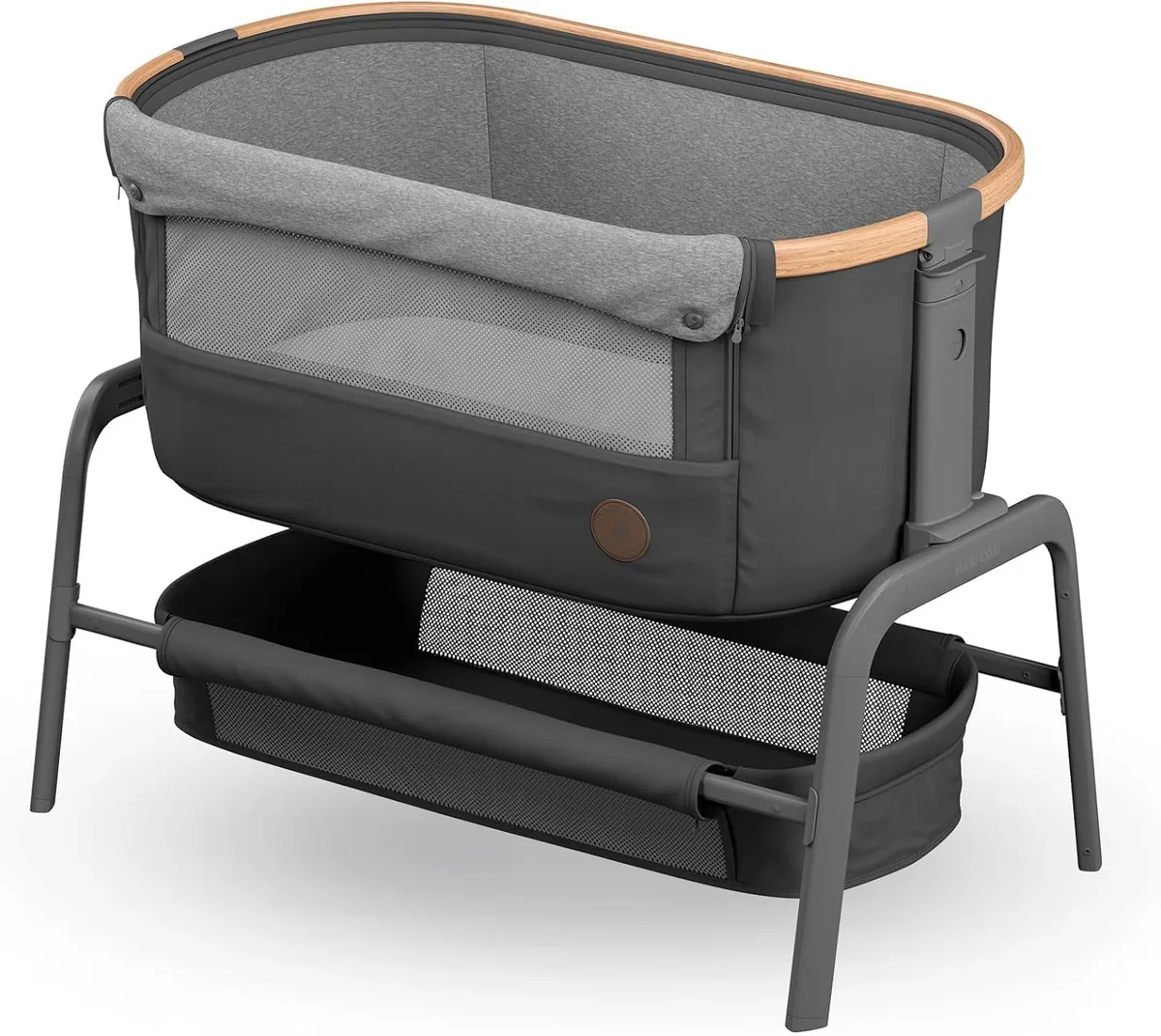
How to choose a bedside crib: the complete guide
A bedside crib is bought with a tape measure first. Before the colour and the options, it has to suit your bed, your bedroom and your nights. Here are the twelve criteria that really matter, in the order you should look at them.
Contents
Start with your nights
Before comparing models, ask yourself a simple question: what do you expect from this sleeping space? A bedside crib meets a specific need: keeping a newborn within arm’s reach at night, in their own space. That need is very strong for parents who breastfeed, for those recovering from a caesarean who struggle to get up, and for those who simply want to hear and see their baby without crossing the room. For other families, a crib placed next to the bed or a cot set up in the parents’ room will do just as well, and last longer.
Then note your constraints. How much space do you have next to the bed? Is your bed standard, or is it an ottoman bed, a low bed, a bed with a thick frame? Do you plan to move the crib to the living room during the day? Do you often stay with relatives? Is your budget tight, knowing that a bedside crib is only used for a few months? These answers shape everything else. They stop you from choosing a model from its photo and then discovering it does not fit your bed.
Also keep in mind the basis of any decision: French health authorities describe room sharing as protective before 6 months, and specify that the crib can be placed against the parents’ bed. A bedside crib is one way of doing this. It is not bed sharing: your baby sleeps in their crib, on their mattress, flat on their back.
| Your priority | The type of sleeping space to favour |
|---|---|
| Frequent night feeds, breastfeeding | Bedside crib, side down, against the parents’ bed |
| Longest possible period of use | Cot with bars, placed in the parents’ bedroom |
| Very small bedroom | Compact bedside crib or narrow crib |
| Moving the crib around the home | Bedside crib or crib with wheels |
| Frequent travel | Light folding bedside crib, or a travel cot |
Deciding together
A bedside crib changes the parents’ bed as much as the baby’s, so it is worth deciding as a couple. A few questions clear things up quickly. On which side of the bed will it go, and is that side compatible? Who will get up most often at night, and does that person sleep on that side? Will the other parent still be able to get out of bed easily? Are you both comfortable with the idea of sharing the room for several months, and do you agree on keeping the baby in their own crib after feeds? Who will check the setup each week? None of these questions has a right answer, but talking about them before buying avoids a crib that ends up on the wrong side, or a setup that only one parent knows how to check. It also helps you agree on the next step, the cot, and where it will go.
Criterion 1: fit with your bed
This is the first criterion, and by far the most important. A bedside crib must attach to the parents’ bed without leaving any gap the baby could slip into. It must also be able to line up with the height of the parents’ mattress. Each manufacturer sets precise conditions for this, found in the instructions, on the product listing or on the packaging. They generally cover three points: the height of the parents’ bed, the shape of its frame, and the gap between the frame and the mattress.
For the Maxi-Cosi Iora, the warning is very clear: the bedside crib must be used with adult beds with a minimum height of 56 cm, frame and mattress included, a frame height of 30 cm minimum and 49 cm maximum, and it must not be used if the gap between the edge of the frame and the mattress is more than 5.5 cm. Other models have other ranges. If a manufacturer publishes no compatibility conditions at all, that is a bad sign: how can you know whether your bed is suitable?
The beds that cause problems most often are well known. Ottoman or storage beds, whose frame goes down to the floor, stop bases from sliding underneath. Very low beds, futons or Japanese-style beds, do not reach the minimum height. High-edged or very thick frames stop the lowered side from touching the mattress. Mattresses narrower than their frame leave a gap at the side. And beds with central legs or a low crossbar sometimes block the base.
The rule is simple: measure before you buy. You need a tape measure and five minutes. Our compatibility calculator checks your measurements for the Iora, and our article will a bedside crib fit my bed? goes through each type of bed.
Criterion 2: height adjustment
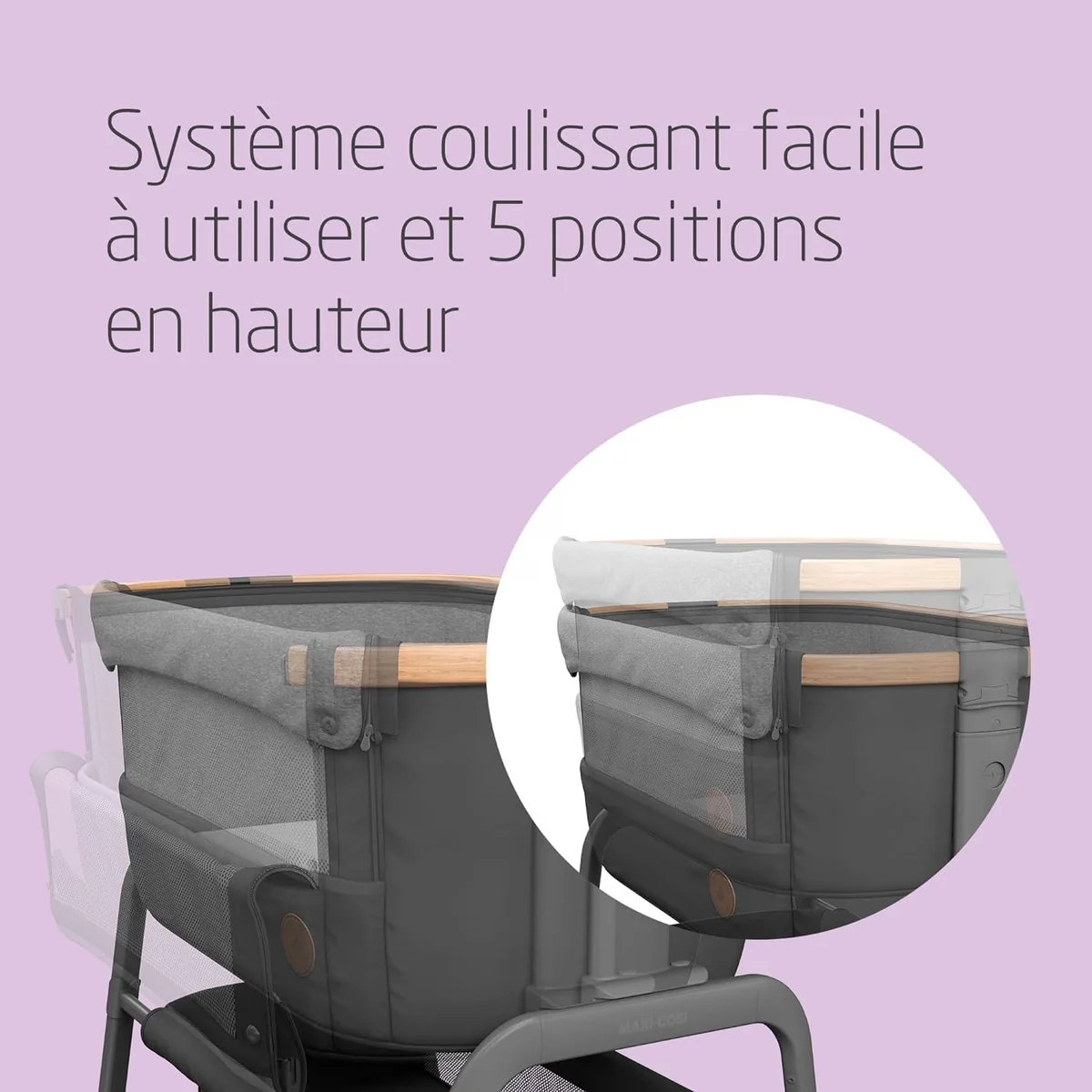
Your baby’s sleeping surface must be positioned relative to your mattress as the instructions say, most often continuing it. To do this, the crib adjusts in height. Two pieces of information matter: the number of positions and the range covered. The more positions, the finer the adjustment. The wider the range, the more beds the crib suits, for example yours and the grandparents’.
The Iora offers five positions, from 74.5 to 85.5 cm according to a specialist retailer, in steps of about 2.75 cm. That is a good level for most standard beds. Be wary of listings that say “height adjustable” without giving any figures: you will not be able to check anything.
The adjustment must also be simple and secure: a mechanism that locks firmly, identical on both sides, and that does not slip over time. Check regularly that the height has not changed, especially if the crib has been moved.
Criterion 3: the holding system
A bedside crib attached to the bed must stay there all night. If it moves a few centimetres away, a gap forms between the two sleeping surfaces. That is the scenario to avoid at all costs. Manufacturers use two main solutions, often combined. The first is a base that slides under the frame of the parents’ bed: the crib moves forward until it touches the mattress and does not rest at an angle. The second is a set of straps linking the crib to the bed, passing under the mattress or around the frame.
The Iora relies on a sliding system, and one comparison also mentions attachment straps. Whatever the solution, always do the same test once setup is finished: push the crib as if to move it away from your bed. It must not move. Our article how to set up and attach a bedside crib details the steps.
Criterion 4: the drop-down side
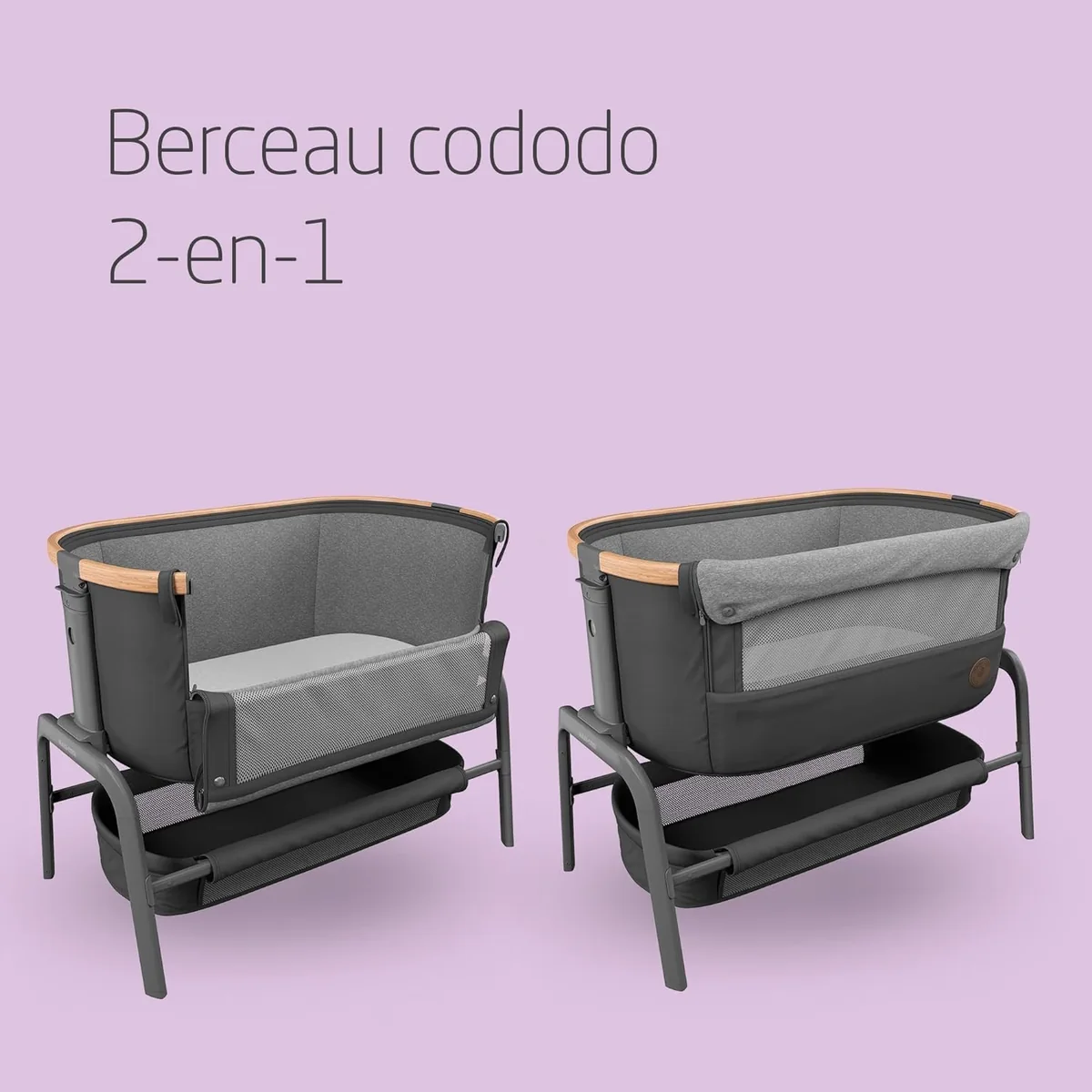
The drop-down side is what distinguishes a bedside crib from an ordinary crib. In the low position, it lets the sleeping surface sit right against your bed. In the high position, it closes the crib. Look at three things: how easy it is to operate, how firmly it locks in the high position, and how the lowered side sits against your mattress. A side that stays slightly raised, or that does not touch the mattress, leaves a gap.
The lowered side must never stay open when the crib is not attached to a compatible bed. It is a rule worth reminding everyone who looks after your baby, grandparents included.
Criterion 5: the mattress
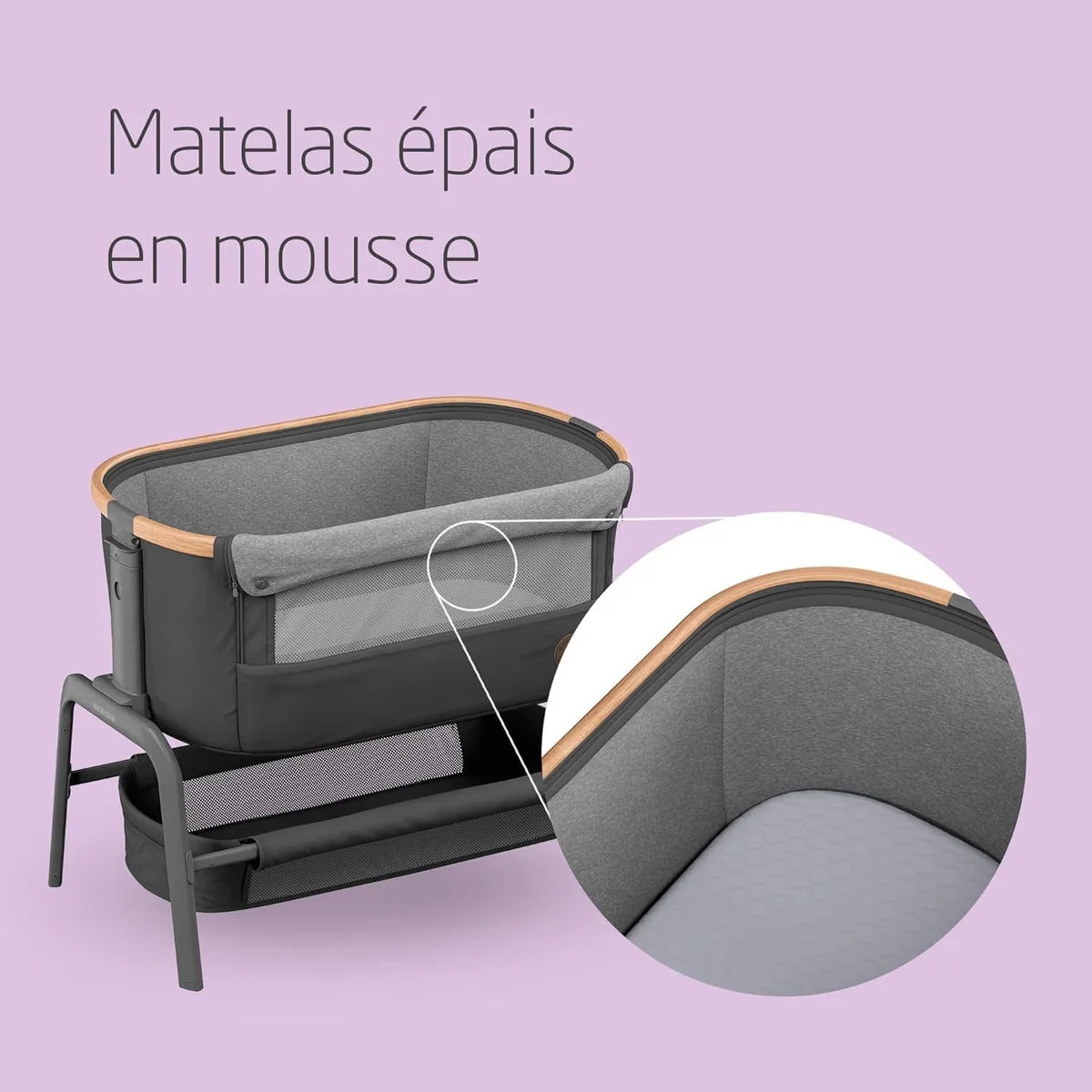
The mattress of a bedside crib is designed for that specific crib. It fits snugly into the basin with no gap at the sides. Safe sleep guidance is consistent: a firm mattress that exactly fits the crib, covered with a well-fitted sheet, and nothing else. Manufacturers often highlight comfort, which is fair enough, but a good baby mattress remains firm: your baby must not sink into it.
Check that the mattress is included, that it is thick and well finished, and that the cover is removable and washable. In Europe, crib mattresses come under EN 16890. Never add a topper, and do not use any mattress other than the manufacturer’s.
Criterion 6: the sheets
Bedside crib mattresses have their own dimensions, which do not always match standard sheets. A sheet that is too big creates folds, one that is too small pulls and comes loose. Before buying, check whether the brand sells fitted sheets of the right size and whether they are easy to find. For the Iora, Maxi-Cosi sells cotton Iora sheets in packs of two. Plan for at least two sets so you can change the bed at night without waiting for the wash.
Criterion 7: age, weight and motor skills
A bedside crib is only used for a few months. Manufacturers often announce a limit of around 6 months and 9 kg. The Iora is announced from birth to about 6 months, up to 9 kg. The EN 1130 standard covers cribs used until the child can sit up unaided, kneel or pull themselves up. For another model in its range, Maxi-Cosi requires moving to a larger bed as soon as the baby can sit up, roll over or push themselves up unaided.
The first limit reached is the one that counts. Many babies start rolling over between 4 and 6 months. Factor this short period into your choice: a very expensive bedside crib is harder to justify if you already know you will buy a cot at around 4 months. Our article moving from a bedside crib to a cot helps you plan the next step.
Criterion 8: the incline
Some bedside cribs, including the Iora, let you incline the sleeping surface. Manufacturers often present this function as a help for reflux. Do not make it a priority criterion. The guidance is clear: babies sleep flat on their back. Sante.fr says so, and the leaflets of US health institutes specify that a safe sleep surface is flat, not inclined. If a bedside crib offers an incline, use the flat position by default and keep the incline for medical advice, following the instructions. See our article bedside crib incline and reflux.
Criterion 9: mesh and visibility
A breathable mesh side has two advantages: it lets air circulate around the sleeping surface, and it lets you see your baby from your bed, even when the side is raised. The Iora has a large mesh window, often described as reassuring by parents. Check the quality of the mesh, its tension and its stitching, and make sure there is nowhere a small finger could get caught.
Criterion 10: use as a crib and mobility
A 2-in-1 bedside crib turns into a standalone crib with the side up. This is useful for naps in the living room, for nights when you prefer a barrier, or when the host bed is not compatible. If you plan to move the crib every day, check whether it has wheels and whether they lock. The Iora has none, which some parents regret. At 10.8 kg, it is moved by lifting it.
Criterion 11: storage and care
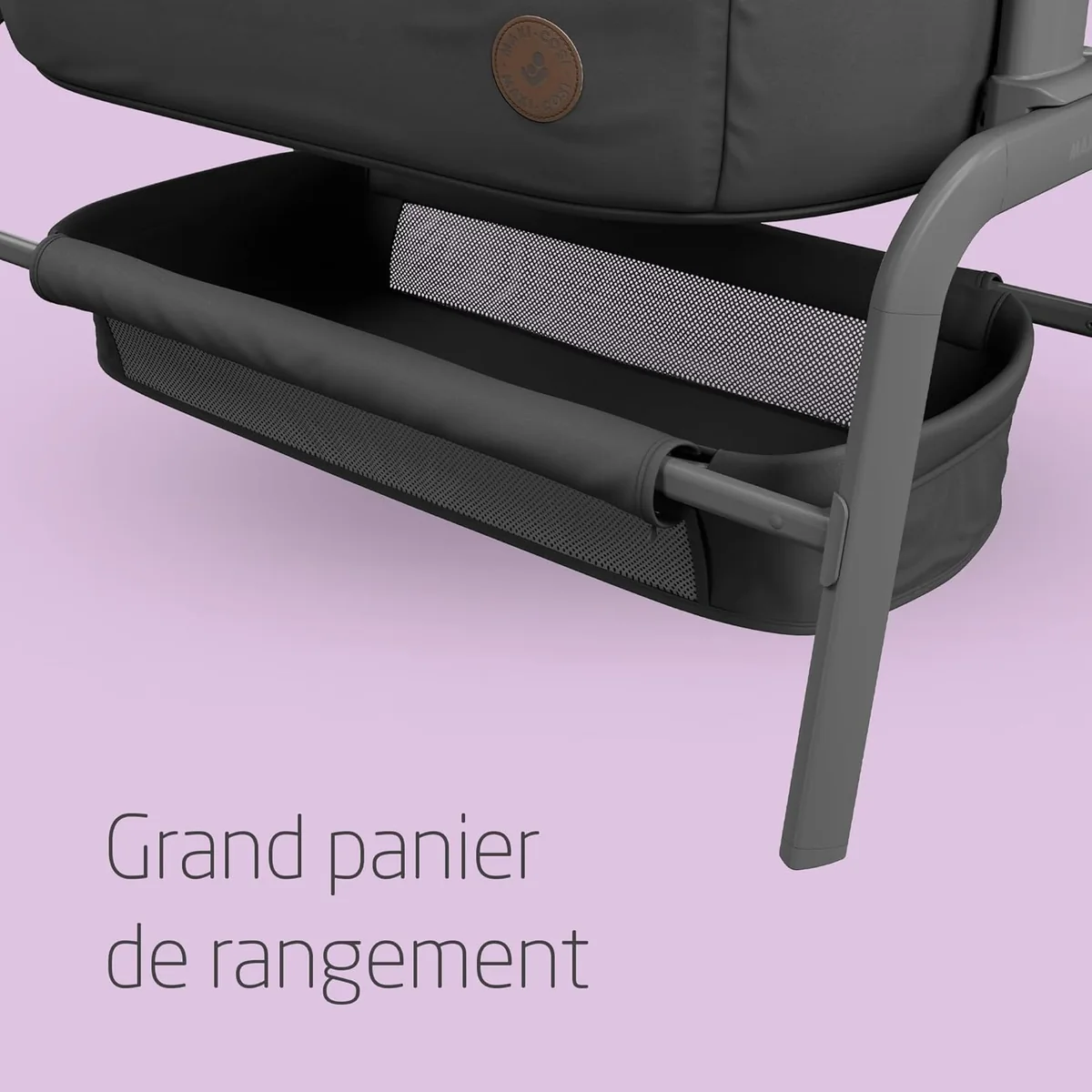
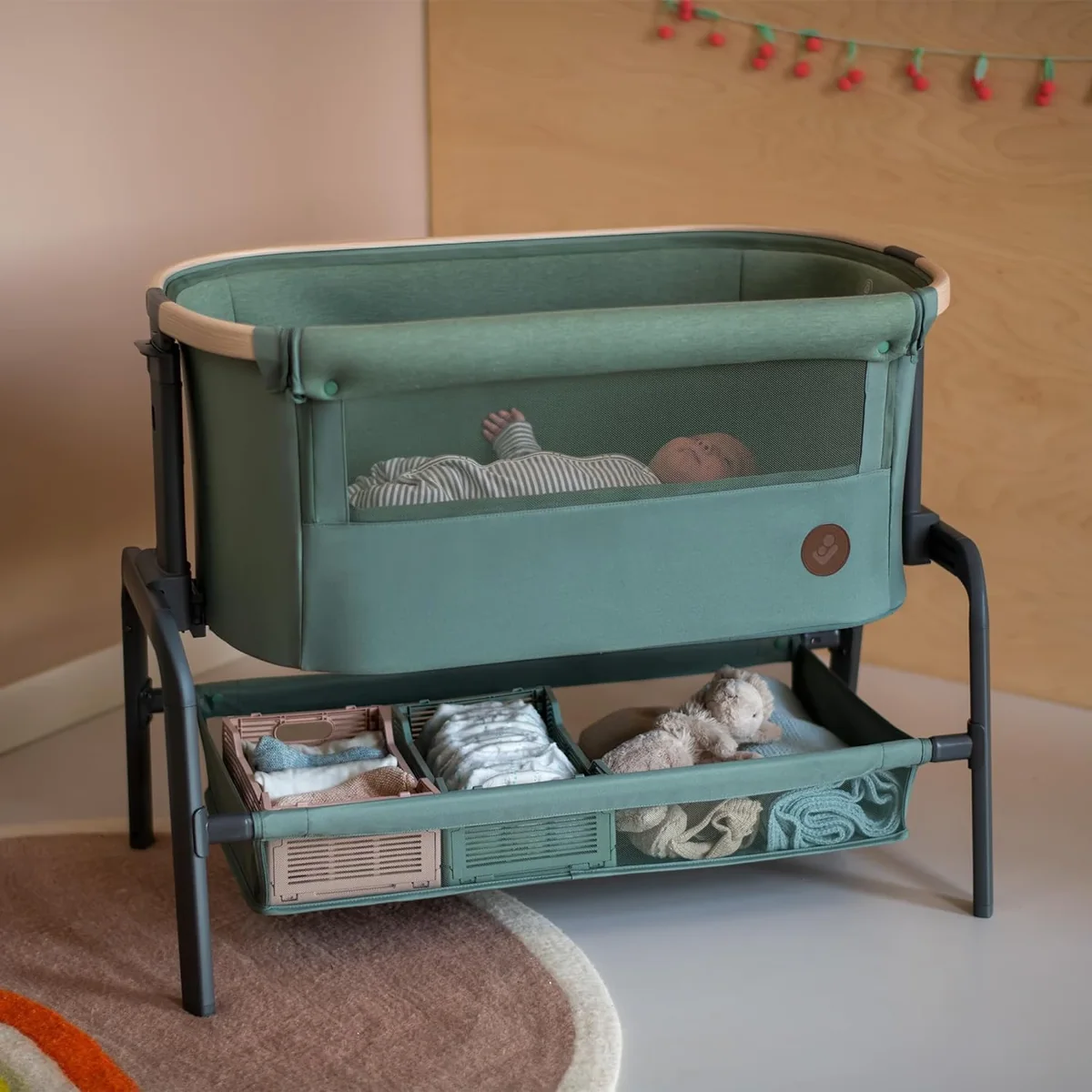
A basket under the sleeping area is genuinely useful at night: nappies, wipes, a bodysuit and a spare sheet stay within reach. For care, choose removable fabrics that can be machine washed. On the Iora, the inner fabrics of the crib and basket unzip and can be machine washed following the label, and the frame is wiped with a damp cloth.
Criterion 12: folding, weight and travel
If you often stay with relatives, folding matters. Look at the folded size, the weight and whether a bag is included. The Iora folds into a bag of 107 x 56 x 18.5 cm and weighs 10.8 kg. That is portable by car, but not light. Remember that the host bed must also be compatible: otherwise, the bedside crib will be used as a standalone crib.
Standards and mandatory labelling
In Europe, the reference standard is EN 1130:2019, which applies to cribs, including rocking and swinging cribs and bedside cribs, for infants until they can sit up unaided, stand up or get onto their hands and knees. It covers materials, construction, sides, stability, instructions and marking. EN 16890 covers mattresses. Check that there are instructions in your language, warnings, identification of the manufacturer or importer, and age and weight limits.
Also be aware that not all authorities view the bedside crib in the same way. Health Canada considers that products intended to be attached to an adult bed are not safe, because of a risk of entrapment. This view underlines the importance of a compatible bed and a setup with no gap. See our article bedside crib safety.
Reading a product listing without being caught out
- Visuals of other versions: bedside crib ranges often have several versions (with wheels, with rocking, lighter). Photos and measurements get mixed up. For the Iora, some visuals show Iora Air measurements.
- “Fits all beds”: no bedside crib fits every bed. Look for the figures.
- “Anti-reflux”: a sales argument, not a medical recommendation.
- “Up to 9 months” or more: check the weight limit and the mention of motor skills.
- “Mattress included”: check its thickness and the availability of sheets.
- Accessories: bumpers, cushions or sleep positioners sold with the bedside crib have no place in the sleeping area.
Budget: what justifies a price difference
Bedside crib prices vary a lot. We do not show any, because they change often. What justifies a difference is the quality of the structure, how fine the height adjustment is, how solid the holding system is, the thickness and finish of the mattress, the presence of a basket, wheels or a bag, and the warranty. What does not justify it is pointless accessories or features you will not use. Also remember the cost of sheets, sold separately, and the short period of use.
Space in the bedroom
A bedside crib takes up about a metre in length and a little over half a metre in width along your bed. Check that you will still be able to move around, open a wardrobe and reach a window. Keep it away from radiators, curtain cords and accessible sockets. The side of the bed matters too: the person who breastfeeds or gets up most often will usually be on the bedside crib side.
New or second-hand?
A bedside crib is only used for a few months, which keeps the second-hand market busy. It is a reasonable option provided you are demanding: an identified model, complete instructions, the original mattress in good condition, no missing parts, no torn mesh, mechanisms that lock firmly. Avoid a bedside crib whose compatibility conditions you cannot find or that has been modified. New, you benefit from the statutory guarantee and, for the Iora, from the warranty extension announced by Maxi-Cosi.
The checklist before ordering
- I have measured my bed’s total height, the frame height and the gap to the mattress.
- These measurements fall within the manufacturer’s conditions.
- The height adjustment covers my bed (and the grandparents’ if needed).
- The holding system is clearly described.
- The mattress is included and sheets of its size are available.
- The age, weight and motor skill limits suit me.
- EN 1130 is stated, and there are instructions in my language.
- The exact model name and colour match what I want.
- I have room to move around the bed.
- I have planned what comes next: a cot after the bedside crib.
An example: the Maxi-Cosi Iora under the microscope
| Criterion | Maxi-Cosi Iora |
|---|---|
| Compatibility | Bed of 56 cm minimum, frame of 30 to 49 cm, gap of 5.5 cm maximum |
| Height | 5 positions, 74.5 to 85.5 cm |
| Holding | Sliding base, straps |
| Mattress | Padded, included |
| Sheets | Sold separately, pack of 2 |
| Age and weight | Birth to about 6 months, 9 kg |
| Incline | 4 positions, flat by default |
| Mesh | Large window |
| Standalone crib | Yes |
| Wheels | No |
| Basket | Large |
| Folding | 107 x 56 x 18.5 cm, bag included, 10.8 kg |
| Standard | EN 1130 |
The Iora ticks most criteria, with two reservations: compatibility, to be checked, and the lack of wheels. Our full review details each point.
Questions to ask the seller
A product listing does not say everything. If you are buying in a shop or can contact the seller, ask these questions. A vague answer is information in itself.
- What are the precise compatibility conditions with the parents’ bed?
- How is the crib held against the bed: sliding, straps, or both?
- How many height positions, and what exact range?
- What are the age, weight and motor skill limits?
- Is the mattress included, and where can I find sheets in its size?
- Are the fabrics removable and machine washable?
- What does the crib weigh and how big is it folded?
- Which standard is stated, and are the instructions in my language?
- What warranty is there, and how can I get spare parts?
Three families, three choices
A spacious bedroom, a standard bed on legs
The bed meets the conditions of most bedside cribs and space is not an issue. The choice comes down to comfort: mattress, mesh, basket, fine adjustment. A 2-in-1 that can be used in the living room is a plus. This is the most favourable case for a model like the Iora.
A studio flat with an ottoman bed
The ottoman base often prevents the base from sliding underneath. A sliding bedside crib is not suitable attached to the bed. A compact crib placed next to the bed is a better option, or a bedside crib whose conditions explicitly accept this type of bed, checked in the instructions.
Parents who often travel
Weight and folding come first. A folding bedside crib with a bag can work, provided you check the host beds. For very frequent travel, a travel cot is a useful complement to the main sleeping space.
Secondary criteria
Once the essential criteria are settled, other details make a difference day to day. Colour, first: a dark fabric like the Iora’s Essential Graphite shows stains less than a light one. The finish of the fabrics: neat stitching, zips that slide well, no label within the baby’s reach. The noise of the mechanisms: a side that creaks or clicks sometimes wakes the baby when you raise it. And the overall look: the bedside crib will stay next to your bed for several months, so you may as well like it.
Bedside cribs to avoid
- A model with no published compatibility conditions.
- A model without instructions in your language or manufacturer identification.
- A model supplied with a bumper, cushion or sleep positioner to put in the sleeping area.
- A model whose mattress seems soft or does not fill the whole basin.
- A model whose side does not lock firmly.
- A model with no clearly stated weight limit.
Think about what comes next now
Choosing a bedside crib also means choosing what comes after. The bedside crib is used up to about 6 months at most. The cot that takes over has to find its place, in your bedroom or in the child’s room. If space is limited, a compact bedside crib now and a cot in the child’s room later is a common combination. If you would rather avoid two purchases, a cot in your bedroom from birth is a simple solution. Our article bedside crib, Moses basket or cot compares these options, and moving from a bedside crib to a cot details the transition.
Choosing in five minutes
No time to read everything? Remember these five checks, in this order. If a model fails one of them, move on to the next.
- My bed meets the model’s compatibility conditions in figures.
- The crib is held against the bed by a clearly described system.
- The mattress is included, firm, and sheets in its size exist.
- EN 1130 is stated and the instructions are in my language.
- The age, weight and motor skill limits are clearly stated.
The rest, basket, mesh, folding, colour, comes afterwards, according to your preferences and your budget.
In short
A good bedside crib is first of all a crib that fits your bed. Next come fine height adjustment, a solid holding system, a firm mattress with sheets in its size, clear age and weight limits, and a stated standard. Comfort, basket, mesh, folding and colour make the difference between good models. Measure your bed, read the instructions, and keep in mind how short this period is so you can plan what comes next.
The most common buying mistakes
- Buying from the photo, without reading the compatibility conditions.
- Choosing a model for its incline rather than its holding system.
- Forgetting that sheets are often sold separately.
- Confusing two versions of the same range.
- Underestimating the crib’s weight if you plan to move it.
- Not planning the cot that will take over.
Frequently asked questions
What is the most important criterion?
Fit with your bed. Without it, the bedside crib cannot be used attached to the bed.
Does a bedside crib fit every bed?
No. Each model has its own height and frame conditions. Measure before you buy.
Do you need wheels?
Only if you plan to move the crib often. Otherwise, they are not essential.
Is the incline a buying criterion?
Not a priority: the recommended sleeping position is flat. The incline is for medical advice.
Which standard should you check?
EN 1130 for the crib, and EN 16890 for the mattress.
The articles in this section
Ready for those first nights?
2-in-1 bedside crib · 0 to 6 months · Up to 9 kg · Travel bag. Prices and colours change often on Amazon: check them, along with the seller, the exact model (Iora, Iora Air, Iora Plus…) and whether it fits your bed, before ordering.
Check the price on AmazonAffiliate link · new tab