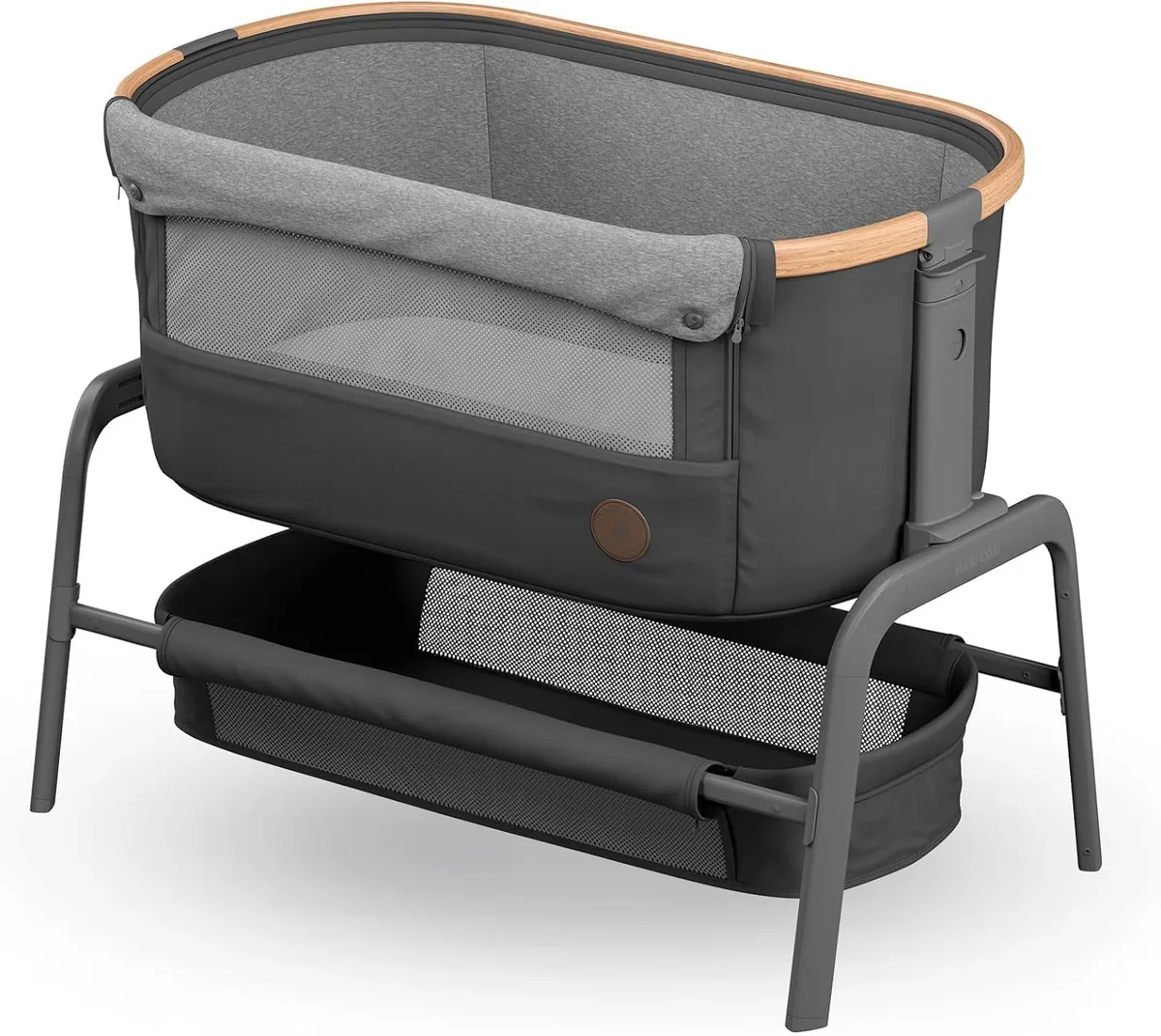
Will a bedside crib fit my bed?
A bedside crib is only safe if it matches your bed perfectly. Three measurements are enough to find out. Here is how to take them, how to read them, and what to do if your bed is not suitable.
Contents
Why compatibility matters so much
A bedside crib makes one promise: to extend your sleeping surface with your baby’s, with no gap between the two. Everything rests on that continuity. If the crib is too high or too low, or if there is a space between its edge and your mattress, the promise no longer holds. A gap, even of a few centimetres, can become an entrapment zone. It is precisely because of this risk that Health Canada considers co-sleeper products intended to be attached to an adult bed unsafe, and recommends a standalone crib placed in the room.
In Europe, these products are covered by EN 1130, and manufacturers publish setup conditions. These conditions are not technical details: they decide whether the bedside crib can be used attached to your bed. That is why we advise checking them before buying, with a simple tape measure.
Compatibility depends on three things: the height of your bed, the shape of its frame, and the way the mattress sits in it. Standard beds on legs, with a slatted base in a frame of average height, are often suitable. Unusual beds need more attention.
The Maxi-Cosi Iora conditions
Maxi-Cosi publishes a very precise warning for the Iora. The bedside crib must be used with adult beds that meet these conditions:
| Measurement | Condition | What it ensures |
|---|---|---|
| Total height (frame + mattress) | 56 cm minimum | Your baby’s sleeping surface can line up with your mattress |
| Bed frame height | 30 cm minimum, 49 cm maximum | The base slides underneath, the lowered side reaches the right level |
| Gap between the frame edge and the mattress | 5.5 cm maximum | No empty space between the two sleeping surfaces |
Above a gap of 5.5 cm, Maxi-Cosi says not to use the bedside crib. These conditions are specific to the Iora: another model, even from the same brand, may have other ranges. Always check the instructions of the model you buy. Our calculator checks these three measurements in seconds.
Taking the three measurements
Stand on the side of the bed where you will put the bedside crib, usually that of the person who breastfeeds or gets up most. Make the bed as usual, with the mattress in place, and take a rigid tape measure.
- The total height. Place the tape measure on the floor, vertically, against the side of the bed, and read the height of the top of the mattress. Measure at two or three points along the length where the crib will go: a worn mattress sometimes sags at the edge.
- The frame height. Measure from the floor to the top edge of the frame, that is the rigid part surrounding the base and mattress. If the mattress overhangs and hides the frame, lift it slightly to find the edge.
- The gap. Measure the distance between the inner edge of the frame and the side of the mattress. Push the mattress slightly towards the centre of the bed to see the maximum possible gap: that is the value that counts, because a mattress moves a little at night.
Also note what is under the bed: legs, crossbars, drawers, an ottoman base. The Iora’s base must be able to slide in. A low crossbar, a drawer or a closed storage base can block the sliding, even if the three measurements are right.
Bed by bed: the common cases
The standard bed on legs
A wooden or metal frame on legs, with a slatted base and a mattress of about 20 cm, is the most favourable case. The total height is often over 56 cm, the frame is within range, and the space under the bed lets the base through. Measure anyway: some very low designer beds or thick frames fall outside the ranges.
The ottoman or storage bed
This is the case that most often causes problems. The storage base goes down to the floor, so the base cannot slide under the bed. The crib then cannot move up to the mattress, or only does so off balance. With an ottoman bed, bedside use is often impossible. The Iora can stay next to the bed as a standalone crib, side up.
The low bed, the futon, the Japanese-style bed
These beds often do not reach the minimum total height, and their frame is sometimes under 30 cm. Your baby’s sleeping surface cannot line up with yours. In these conditions, the Iora is not compatible as a bedside crib.
The divan base without a frame
A divan base on legs, with no frame around it, does not match Maxi-Cosi’s warning, which is based on frame height. Measure the height of the divan as you would a frame and check that the base can slide underneath, then refer to the instructions. If in doubt, contact the brand’s customer service.
The thick or high-edged frame
Some beds have a frame that rises above the base, or even the mattress. The lowered side of the crib then hits the edge and cannot touch the mattress. The resulting gap may exceed the limit. Measure the gap between the edge and the mattress carefully.
The electric or adjustable bed
A bed whose head or foot rises changes shape during the night. The mattress may move away from the edge or rise above the crib. This case is not covered by the Iora’s warning: only use bedside mode with the bed flat, and ask the manufacturer.
The large bed made of two mattresses
The centre of the bed does not matter: only the side where you put the bedside crib counts. Check that this mattress does not slide towards the centre, which would open a gap on the crib side.
The parents’ mattress matters too
A soft mattress sags at the edge when you sit or lie near the crib, which changes the alignment. A mattress narrower than its frame leaves a gap at the side. A thick topper raises the total height, but can also overhang towards the crib. Check your measurements with the bedding you actually use. And make sure your duvet and pillows never slide towards your baby’s sleeping surface.
The floor matters as well
The bedside crib stands on the floor, not on your bed, so the floor under it plays a part too. A thick, soft rug can make the base less stable and slightly lower one side, which spoils the alignment and can open a gap once you lean on the edge of your bed. An uneven floor, an old floorboard or a threshold strip under one of the feet has the same effect. Skirting boards and radiators sometimes stop the parents’ bed from being pushed right against the wall, so the bed moves a little when you get in and out, taking the mattress with it. Check that the crib stands level on a firm surface, that its feet do not rock, and that the parents’ bed itself does not slide. If your bed has castors, lock them, or place it so it cannot move. Then do the push test again.
Your bed is not suitable: the solutions
- Use the Iora as a standalone crib, side up and locked, placed against your bed or right next to it. You lose the continuity between the sleeping surfaces, but keep your baby in your room, as health authorities recommend.
- Choose another model whose compatibility conditions match your bed, checking its published measurements.
- Opt for a standard crib or a cot in your room. See our article bedside crib, Moses basket or cot.
- Replace the frame or the base, if you were already planning to: a standard bed on legs makes it easier to set up a bedside crib. Obviously this is not an expense to make just for a few months.
False solutions to avoid
- Filling a gap with a rolled-up blanket, a cushion or a towel.
- Raising the crib on wedges, books or boards.
- Adding a second mattress in the crib to gain height.
- Using bedside mode “just for feeds” on a bed that is not compatible.
- Improvising an attachment with straps or tensioners that were not supplied.
All these solutions create a risk: a textile can cover your baby’s face, a wedge can slip, a makeshift fix can give way. The instructions describe the only intended setup.
At the grandparents’ and on holiday
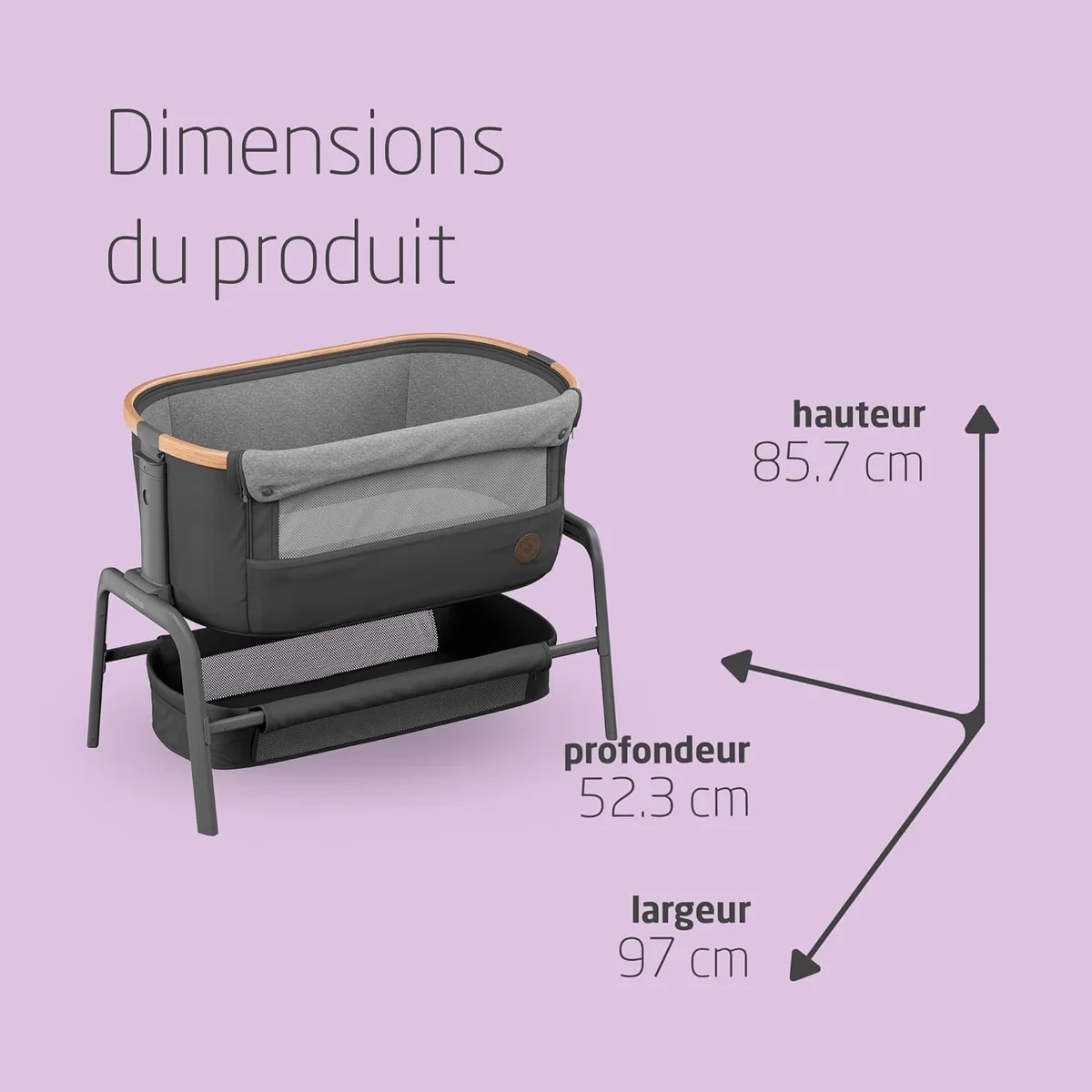
The Iora folds into a bag of 107 x 56 x 18.5 cm and weighs 10.8 kg. It can travel. But the host bed must meet the same conditions as yours. Ask your relatives to take the three measurements before your visit. If the bed is not suitable, the Iora will be used as a standalone crib, side up. For frequent trips, a travel cot may be simpler.
Three example measurements
| Example | Total height | Frame | Gap | Result for the Iora |
|---|---|---|---|---|
| Bed on legs, 20 cm mattress | 60 cm | 38 cm | 2 cm | Compatible |
| Low designer bed | 48 cm | 25 cm | 1 cm | Not compatible: total height and frame too low |
| Wide frame, narrow mattress | 62 cm | 40 cm | 7 cm | Not compatible: gap over 5.5 cm |
These examples are fictitious and only illustrate how to read the three conditions. Always take your own measurements, on your bed, with your bedding.
Measuring traps
- Measuring without the mattress: the total height is measured with the mattress in place.
- Measuring in the middle of the bed: only the side where the bedside crib will go counts.
- Forgetting the topper: it changes the total height and may overhang.
- Measuring the gap with the mattress pushed against the edge: push it towards the centre to see the maximum gap.
- Confusing frame and base: the frame is the rigid part surrounding the base.
If you change mattress
A new parents’ mattress can change everything. Thicker, it increases the total height. Narrower than the old one, it can open a gap with the frame. Softer, it sags more at the edge. If you plan to change mattress around the birth, do it before setting up the bedside crib, then take the three measurements again. Do not change mattress while the bedside crib is in use without checking everything again.
When to contact the manufacturer
If your bed is out of the ordinary, or if a measurement is at the limit, the manufacturer’s customer service is the best contact. Send them your three measurements, a description of the bed and, if possible, a photo. They can tell you whether their model can be used as a bedside crib in these conditions. Keep their written answer with the instructions.
The right reflex in one diagram
- I measure my bed, on the bedside crib side, with my usual bedding.
- I compare with the conditions in the instructions: 56 cm minimum, frame of 30 to 49 cm, gap of 5.5 cm maximum for the Iora.
- I check under the bed: the base must be able to slide in.
- If everything is fine, I set up the bedside crib and do the push test.
- If a condition is missing, I use the crib standalone, side up, or I choose another sleeping space.
What if only one side of the bed is compatible?
Sometimes one side of the bed is suitable and the other is not: a fixed bedside table, a radiator, a wall, a socket, a different frame. In that case, set up the bedside crib on the compatible side, even if it is not the breastfeeding parent’s side. Parents can swap places in bed for a few months. It is a simple solution, far safer than setting up the bedside crib on a side that does not meet the conditions.
Also think about moving around at night: the person on the crib side must be able to get up without climbing over the crib. Leave a passage at the foot of the bed or on the other side.
Why such precise ranges?
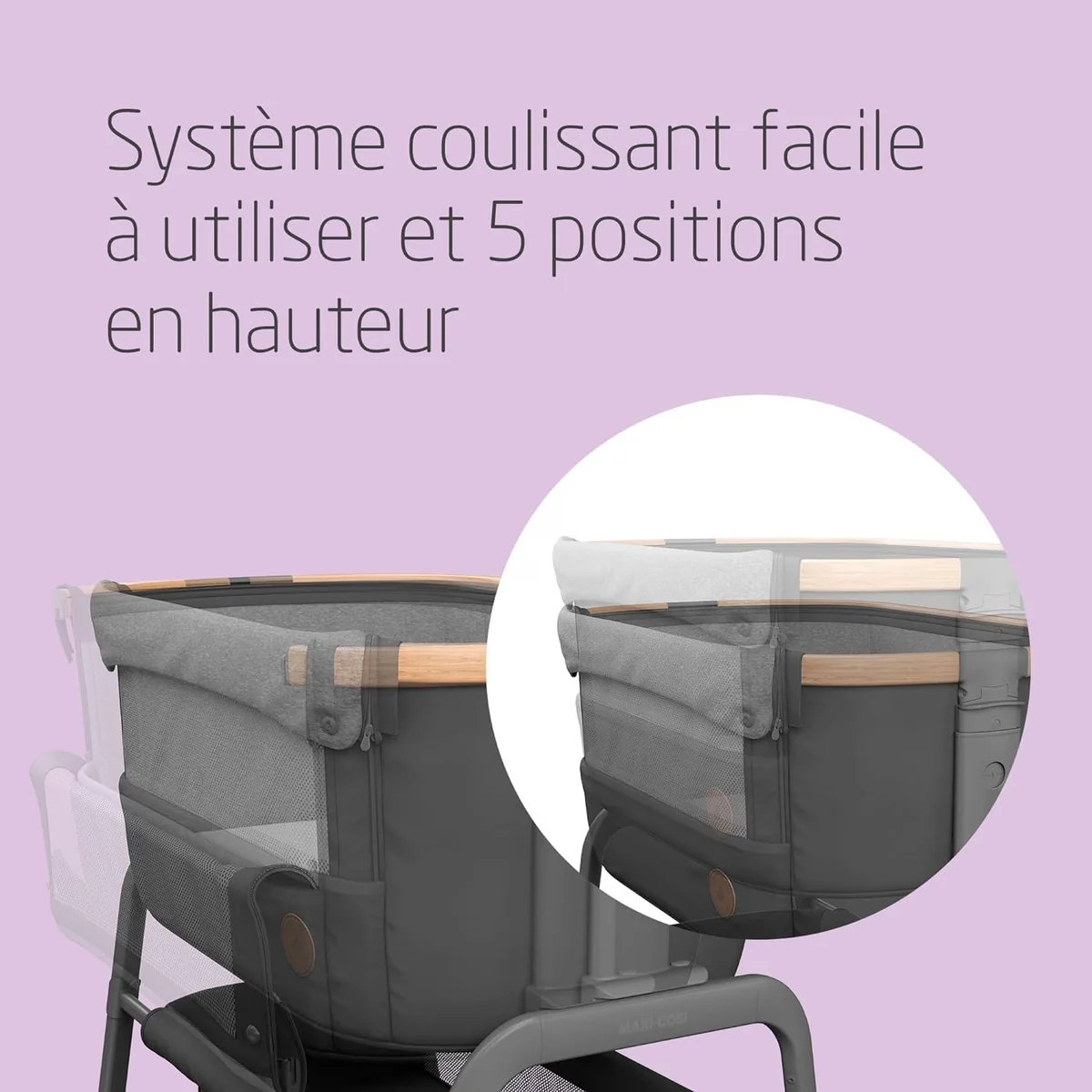
You may be surprised that a manufacturer sets limits to the centimetre. They come from the design of the crib. The Iora’s base has a given height to slide under the frame: a frame that is too low blocks it, one that is too high leaves the lowered side below the level of the mattress. The crib’s five heights cover a precise range, from 74.5 to 85.5 cm according to a retailer: a bed that is too low cannot be matched. And the 5.5 cm gap limit corresponds to what the crib can close by coming into contact with the mattress. Outside these ranges, the manufacturer can no longer guarantee a setup with no gap. That is why respecting them is the only way to use bedside mode safely.
The essentials on compatibility
Three measurements decide everything: the total height of the bed, the height of the frame and the gap between the frame and the mattress. For the Maxi-Cosi Iora, you need at least 56 cm, a frame of 30 to 49 cm and a gap of no more than 5.5 cm. The space under the bed must let the base through. If a condition is missing, the Iora can still be used as a standalone crib, side up, in your room. Never try to compensate with a textile or a wedge.
Frequently asked questions
My bed is 55 cm in total height: is it compatible?
No, Maxi-Cosi requires at least 56 cm for the Iora. Use it as a standalone crib.
My frame is 50 cm: what should I do?
Above 49 cm, the frame is out of range for the Iora as a bedside crib.
Is an ottoman bed always incompatible?
Most often, because the base cannot slide underneath. Measure and check the clearance.
Can I fill a 7 cm gap?
No. Above 5.5 cm, Maxi-Cosi says not to use the bedside crib.
Are the conditions the same for all bedside cribs?
No. Each model has its own: read the instructions for yours.
Ready for those first nights?
2-in-1 bedside crib · 0 to 6 months · Up to 9 kg · Travel bag. Prices and colours change often on Amazon: check them, along with the seller, the exact model (Iora, Iora Air, Iora Plus…) and whether it fits your bed, before ordering.
Check the price on AmazonAffiliate link · new tab