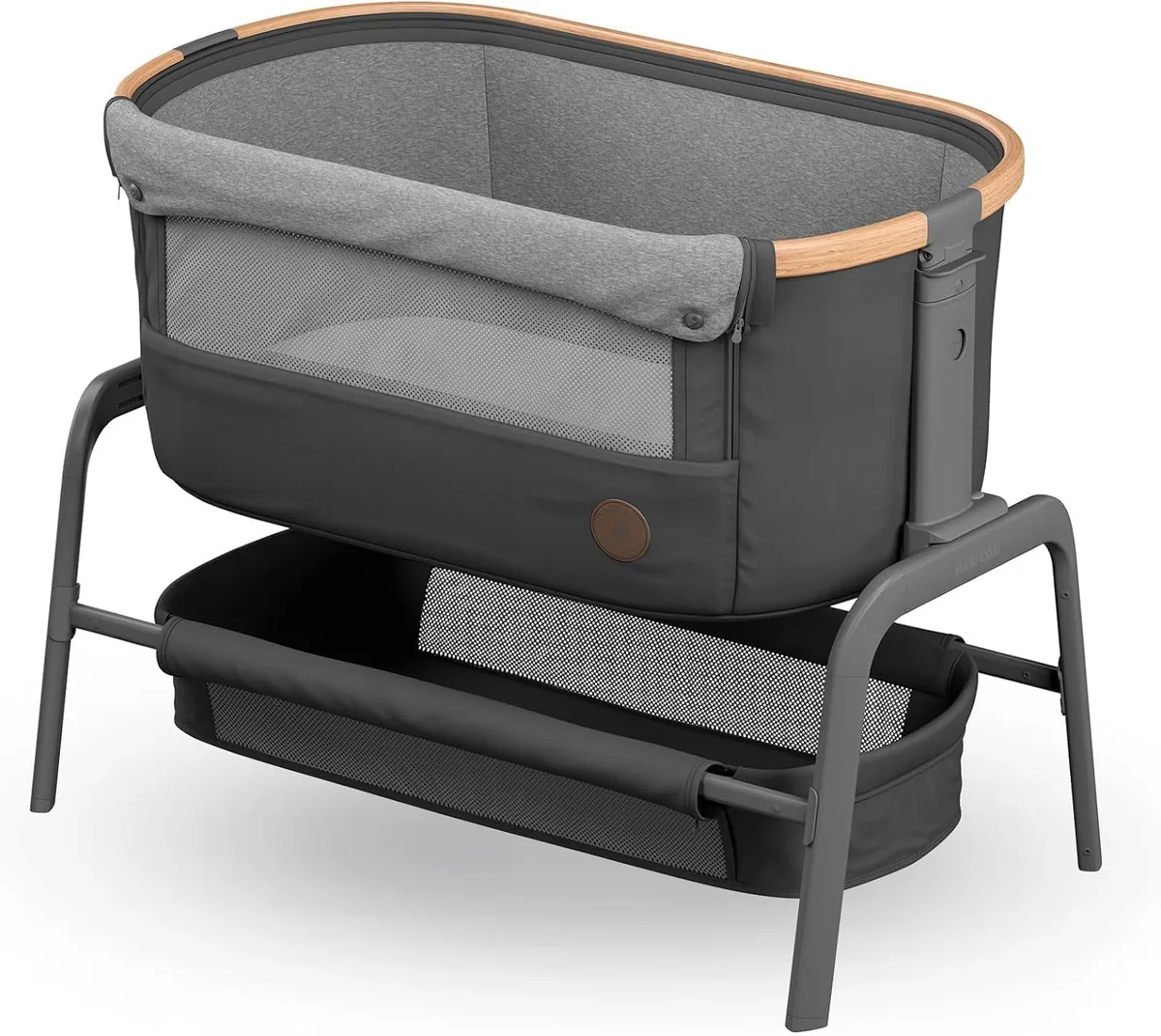
Bedside crib safety: the complete guide
A bedside crib keeps baby right next to you, in their own sleep space. Its safety rests on three pillars: a compliant product, a gap-free setup on a compatible bed, and the basic rules of infant sleep. Here is everything you need to know.
Contents
What health authorities say
In France, the official position on room sharing is clear. The public health site sante.fr states that studies show room sharing with baby is a protective factor against sudden infant death, and that the crib can be placed against the parents’ bed for the first months. That is precisely what a bedside crib does: baby sleeps in your room, in their own sleep space, right against your bed. In the UK, the NHS likewise advises that baby sleeps in the same room as you for the first 6 months.
The same site recalls the basic sleep rules: to prevent the risk of sudden unexpected infant death and support healthy motor development, baby must always be laid flat on their back on a firm mattress. The safe sleep leaflets from the US National Institutes of Health point the same way: a firm, flat, level sleep surface covered only with a fitted sheet, no soft objects or bedding in the sleep space, and sharing the room, but not the bed, for at least the first months.
These recommendations do not say that any sleep space is safe by nature. They describe conditions. A bedside crib meets the room-sharing recommendation, provided it is used as the manufacturer and the sleep rules intend.
A product that divides opinion
Not every authority reads bedside cribs the same way. Health Canada considers that co-sleeping products designed to attach to an adult bed are not safe, because of a risk of entrapment between the product and the adult bed, and recommends using a compliant crib, cradle or bassinet placed in the parents’ room.
In Europe, these products are covered by a standard, EN 1130, which applies to cribs and cradles, including bedside cribs, and sets requirements for construction and instructions. This disagreement between authorities is telling. It does not mean that a compliant bedside crib is dangerous in itself, but it shows where the risk lies: the interface between the bedside crib and the parents’ bed. A gap between the two surfaces, a crib that moves away, a soft parental mattress that sags: that is where it all happens. That is why this guide puts so much emphasis on compatibility and setup.
Our position: we present the bedside crib as a way of sharing the room while keeping baby very close, provided the setup conditions are strictly respected. If your bed is not compatible, a standalone crib placed next to your bed is a safe, recommended alternative.
A bedside crib is not bed sharing
“Co-sleeping” is used in two senses, which causes confusion. In everyday language, it sometimes means sleeping with baby in the parents’ bed. A bedside crib, on the other hand, is a separate crib. The difference is essential. Bed sharing exposes baby to risks that health authorities describe: adult duvets and pillows, a soft mattress, a gap between the mattress and the wall or headboard, an adult turning over in their sleep. In a bedside crib, baby has their own firm mattress, their own surface, and no adult bedding.
A bedside crib only helps if baby actually sleeps in it. After a feed, baby goes back in the crib. If baby ends the night in the parents’ bed, the bedside crib no longer provides its protection.

The EN 1130 standard
The European standard EN 1130:2019, “Children’s furniture, cribs and cradles, safety requirements and test methods”, applies to cribs and cradles, including rocking and swinging cradles and bedside cribs, for infants until they can sit up, stand up or get onto their hands and knees unaided. It covers in particular materials, construction, the base, the sides, stability, packaging, the instructions for use and marking. It sets a maximum internal length of 900 mm. Another standard, EN 16890, covers crib mattresses.
The Maxi-Cosi Iora is stated to comply with EN 1130. A standard does not guarantee everything: it tests a product under defined conditions. It is up to the user to meet those conditions, which means following the instructions.
The three pillars of safety
- A compatible bed: your bed meets the manufacturer’s conditions.
- No gap, no movement: the bedside crib is pressed and held against the parents’ mattress, at the right height.
- A safe sleep space: baby on their back, flat, on the mattress supplied, with nothing else.
If one of these pillars is missing, safety is not assured. If your bed is not compatible, do not use bedside mode: raise the side and use the crib as a standalone crib.
Pillar 1: a compatible bed
Every bedside crib has its own conditions. For the Maxi-Cosi Iora, the manufacturer’s warning requires an adult bed with a minimum height of 56 cm (total height of frame and mattress), a frame height of at least 30 cm and at most 49 cm, and forbids using the bedside crib if the gap between the edge of the frame and the mattress is more than 5.5 cm. These three measurements are taken with a tape measure. Our calculator checks them, and our compatibility article covers each type of bed.
Ottoman storage beds, low beds, frames with a high lip and electric adjustable beds often cause problems. Never try to make up for an incompatibility with a wedge, a cushion or a blanket.
Pillar 2: no gap, no movement
The heart of bedside crib safety is the absence of any gap between its sleep surface and the parents’ mattress. A gap where baby’s head, arm or body could slip creates a risk of entrapment. That is exactly the risk Health Canada cites.
To avoid it, the bedside crib must be pressed against the mattress and stay there. The Iora uses a base that slides under the bed frame and an attachment system described in the instructions. Once it is set up, do the push test: press firmly on the crib as if to push it away from the bed. It must not move, and no gap must appear. Repeat this test regularly, and after every time the bed or the crib is moved. Our article setting up and attaching a bedside crib explains the method.
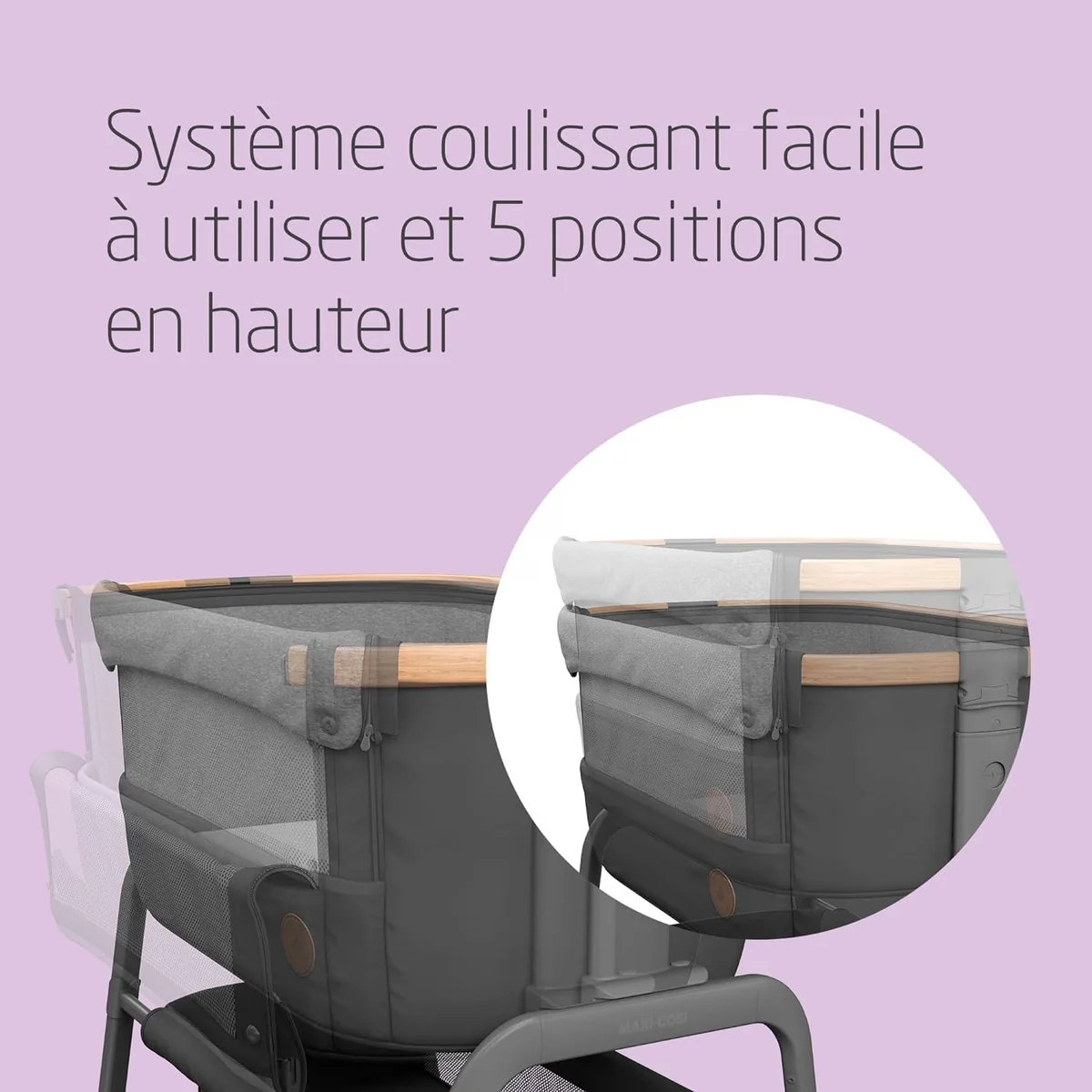
Height matters too. Baby’s sleep surface must be positioned in relation to your mattress as the instructions state. A crib that is too low creates a step where baby could slide towards the edge; a crib that is too high can let your mattress move away underneath.
Pillar 3: a safe sleep space
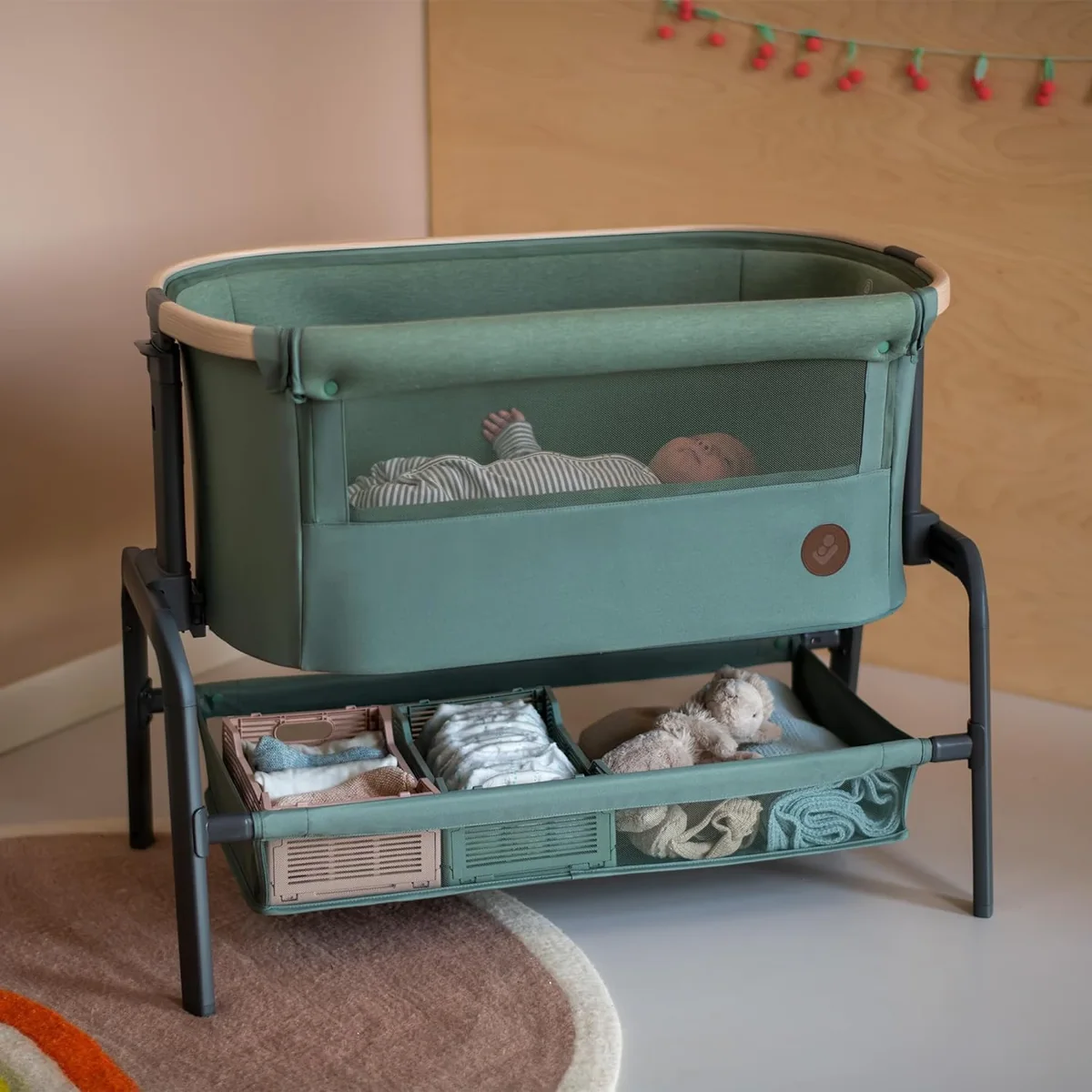
- Baby is laid on their back, for every night and every nap.
- Flat, on the firm mattress supplied with the bedside crib.
- With a well-fitting fitted sheet, the exact size of the mattress.
- In a sleeping bag suited to their size, with no blanket or duvet.
- With no pillow, bumper, soft toy, cushion, wedge or any other object.
- With the face clear and the head uncovered.
These rules apply whatever the sleep space. They are set out by sante.fr and by health authorities in other countries. Lay baby in the middle of the mattress, not against the edge on the parents’ side.
The mattress and bedding
Only use the mattress supplied with the bedside crib. It is designed to fit into the crib with no gaps at the sides. Do not add a topper, a second mattress or a folded blanket to make it softer: a baby mattress must stay firm. Sheets must be the right size: Maxi-Cosi sells cotton Iora sheets in packs of two. A sheet that is too big forms folds where baby’s face can nestle, and a loosely fitted sheet can come off.
The incline
The Iora offers four incline positions, which Maxi-Cosi presents as a help in case of reflux. The recommendations stay the same: baby sleeps flat on their back. The US leaflets specify that a safe sleep surface is flat, not inclined. Our advice: use the flat position by default, and only use an incline on the advice of your paediatrician or GP, following the instructions. More details in our article incline and reflux.
The parents’ bed
The parents’ bed is part of the setup. Its duvet and pillows must never spill over towards the crib. Many parents place their pillow slightly back from the edge on the bedside crib side and use a duvet that does not hang down. A soft parental mattress that sags at the edge can create a gap: check the alignment by sitting on the edge of the bed. Do not let an older child or a pet sleep in the parents’ bed on the bedside crib side.
Risky situations
Some situations increase the risk at night. In these cases, raise the side of the crib to make it standalone, or put baby a little further away, still in your room:
- a parent has drunk alcohol or taken drugs;
- a parent has taken medication that causes drowsiness;
- a parent smokes, even outside the bedroom;
- a parent is extremely tired or unwell;
- an older child or a pet shares the parents’ bed.
Never fall asleep with baby on a sofa or in an armchair: health authorities describe these as particularly dangerous situations.
The room and the environment
- A room at a moderate temperature, around 18 to 20 °C according to common recommendations, never overheated.
- A smoke-free room, aired every day.
- The bedside crib away from radiators, heat sources and windows.
- No curtain or blind cords or electric cables within baby’s reach.
- Nothing hanging above the crib that could fall.
- A baby monitor, if used, placed out of reach along with its cable.
Age, weight and movement limits
A bedside crib is a crib, designed for an infant who cannot yet move around. The Iora is stated for use up to around 6 months and 9 kg. The EN 1130 standard applies to infants until they can sit up, kneel or pull themselves up unaided. For another model in its range, Maxi-Cosi asks parents to stop as soon as baby can sit up, roll over or pull up unaided. The first limit reached is the one that counts. See our article moving on from a bedside crib.
Regular checks
A bedside crib that was set up properly on day one can drift over time: you make the bed, the mattress shifts, the crib gets knocked. Get into the habit of a weekly check:
- The crib is still pressed against the mattress: push test.
- The height has not changed, on both sides.
- The attachment system is in place and tight.
- The joints are locked.
- The mesh is neither torn nor slack.
- The mattress sits properly and the sheet is tight.
- Nothing has fallen into the crib or the space around it.
If a part is damaged or missing, stop using the bedside crib and contact the manufacturer. Only use original parts.
Safety when buying
Choose a bedside crib that complies with EN 1130, with instructions in English, clear warnings, the manufacturer’s details and compatibility conditions given in figures. On a marketplace, check the exact model name: the Iora range has several versions with different features. Second-hand, turn down a bedside crib that is incomplete, without instructions, modified or damaged. Our guide how to choose a bedside crib covers the criteria.
In an emergency
If baby is not breathing, does not respond, changes colour or seems in distress, call 999 or 112 immediately. Follow the instructions you are given. It is worth taking a baby and child first aid course, which several organisations offer.
Myths about bedside crib safety
“Baby doesn’t move yet, so a small gap is fine”
False. Even a newborn moves around the sleep space by wriggling, pushing with their feet and turning their head. A gap between the two surfaces can become an entrapment zone. No gap is acceptable, and for the Iora, Maxi-Cosi forbids use if the gap between the frame and the mattress is more than 5.5 cm.
“A bumper protects baby from knocks”
False. The recommendations call for a sleep space without bumpers, cushions or soft objects. A bumper can obstruct breathing if baby presses their face against it. A compliant bedside crib does not need one.
“On their side, baby can’t choke”
False. Sante.fr reminds parents that baby must be laid flat on their back. Lying on their side, baby can roll onto their tummy. The back is the recommended position for every night and every nap.
“With a bedside crib, we can keep baby in our bed”
False. The bedside crib is there precisely so that baby sleeps in their own sleep space. After a feed, baby goes back in the crib.
“The incline stops spit-ups, so it’s safer”
False. The recommendations call for a flat sleep surface. The incline is for use on medical advice only.
“A second-hand bedside crib is as good as a new one”
Not always. A bedside crib that is incomplete, without instructions, with a worn mattress or torn mesh no longer offers the same guarantees. Second-hand, be very demanding.
When someone else puts baby to bed
Grandparents, a babysitter or a relative may end up putting baby to bed. They may not know the bedside crib or the current recommendations, which have changed a great deal in a few decades. Take the time to explain:
- baby goes to sleep on their back, flat, in a sleeping bag;
- nothing else in the crib, not even a small blanket;
- the side is raised and locked if the crib is not pressed against a bed;
- baby is not kept in an adult bed or on a sofa to sleep;
- the room stays at a moderate temperature and smoke-free;
- 999 or 112 in an emergency.
Leave the instructions and a sheet with these rules near the crib.
Pets
A cat or dog may be drawn to the crib, its warmth and its smell. Never let a pet sleep in the crib or in the parents’ bed on the bedside crib side. If your pet is used to sleeping in your bedroom, it can help to get it used to sleeping elsewhere before the birth. At night, keep the bedroom door closed if necessary.
Smoking, alcohol and medication
Health authorities cite exposure to tobacco smoke as a risk factor for sudden unexpected infant death. Do not smoke in the house or the car, and keep smoke away from baby. Smoking matters even when a parent smokes elsewhere: it is one of the situations in which the close proximity of shared sleep is advised against. Alcohol, drugs and medication that cause drowsiness reduce alertness. In these situations, raise the side of the bedside crib and, if possible, leave night-time care to the other parent. If you need help to stop smoking, talk to your GP, midwife or local stop smoking service.
Product recalls and safety information
Nursery products are sometimes recalled. In the UK, product recalls and safety alerts are published on GOV.UK by the Office for Product Safety and Standards; in the European Union, the official Safety Gate portal lists dangerous products. Registering your product with the manufacturer, as Maxi-Cosi offers for its warranty extension, can also keep you informed. Keep the exact reference of your model and its purchase date with the instructions. If you notice a defect, stop using it and contact the manufacturer.
Safety away from home
At relatives’ homes, in a hotel or a holiday rental, the bed is not yours. Take the three measurements again before setting up the bedside crib. If the bed is not compatible, use the crib in standalone mode, with the side raised, next to the bed. Check the surroundings too: radiators, windows, curtain cords, sockets, stairs. Keep the same sleep rules. Nights away from home are often the ones where people improvise: that is exactly when you need to stay rigorous.
Learning first aid
A baby and child first aid course teaches you how to react if baby chokes, stops breathing or becomes unwell. Organisations such as the British Red Cross and St John Ambulance offer them, often in a few hours. It is an investment of time that reassures many parents, and grandparents can take one too.
Safety through the night
At bedtime
Baby is laid on their back, in the middle of the mattress, in a sleeping bag. The sleep surface is flat. You check at a glance that nothing else is in the crib, that the bedside crib is pressed against the bed and that your duvet is not spilling over.
During wake-ups
You pick baby up for the breastfeed or bottle, in a soft light. You stay alert to the risk of falling asleep with baby in your arms. Once the feed is over, you put baby back in the crib, on their back.
In the early hours
The last wake-ups, often the hardest, are the ones when you keep baby against you “just a little longer”. If you are very tired, ask the other parent to take over, or put baby back in the crib before you drift off again.
In the morning
When you make the bed, you check the setup without pulling on the parents’ mattress. You air the room. Once a week, you do the full check described above.
Reading the instructions, properly
The instructions are the most underrated safety document in the nursery. They are where the manufacturer sets out the conditions under which the product was tested: compatible beds, how the attachment system works, height settings, age and weight limits, and the warnings that apply to that particular model. Read them before the first assembly, not after a problem. Then read them a second time with the crib in front of you, checking each step as you go. Keep them in the crib’s bag or in a drawer in the bedroom, and photograph the key pages on your phone so you have them when travelling. If you buy second-hand and the instructions are missing, look for them on the manufacturer’s website before using the crib. And when the instructions and a piece of advice from someone else disagree, the instructions win: they describe this product, not bedside cribs in general.
Our sources
This guide is based on the recommendations published by sante.fr on infant sleep and room sharing, the safe sleep leaflets from the US National Institutes of Health, Health Canada’s position on products attached to adult beds, the description of the EN 1130:2019 standard published by standards bodies, and the Maxi-Cosi Iora compatibility warning. We are not health professionals: for any question about your baby, speak to your GP, midwife or health visitor. More details on our method on the affiliate transparency page.
Sudden infant death: what you need to know
Sudden unexpected infant death refers to the sudden death of an apparently healthy baby, most often during sleep. It is a fear many parents share. Health authorities have identified measures that reduce the risk, and these are the basis of the recommendations in this guide: lay baby on their back, on a firm mattress, in a clear sleep space, with no tobacco smoke around them, in a room that is not overheated, and share the parents’ room for the first months. A bedside crib fits within these measures, provided its own setup rules are respected.
These recommendations should not become a source of constant anxiety. They are simple, and once in place, they become habits. If you have questions or worries, talk to your GP, midwife or health visitor: they are there to support you.
Bedside crib safety in ten rules
- A bedside crib that complies with EN 1130, with its instructions.
- A parents’ bed that meets the manufacturer’s conditions.
- No gap between the crib and the parents’ mattress.
- A firm attachment, checked with the push test.
- Baby on their back, flat, in the middle of the mattress.
- The mattress supplied, a fitted sheet, nothing else.
- A sleeping bag instead of any blanket.
- The parents’ duvet and pillows kept away from the crib.
- The side raised after alcohol, medication, smoking or in case of great tiredness.
- Stopping at the first age, weight or movement limit.
The Maxi-Cosi Iora and these rules
Applied to the Iora, these rules are simple. Check Maxi-Cosi’s three compatibility conditions before any use in bedside mode. Slide the base under the bed, fit the attachment provided in the instructions and do the push test. Set the height according to the instructions, the same on both sides. Keep the sleep surface flat, with the mattress supplied and a well-fitting Iora sheet. Raise and lock the side as soon as the crib is no longer against a compatible bed. And stop using it at 9 kg, around 6 months, or as soon as baby rolls over, sits up or pulls up unaided. Our user guide goes through these steps one by one.
Frequently asked questions
Is a bedside crib dangerous?
When compliant, set up with no gap on a compatible bed and used with a safe sleep space, it allows the room sharing that health authorities describe as protective. The main risk is a gap between the two sleep surfaces.
Why does Health Canada advise against it?
Health Canada considers that products attached to an adult bed present a risk of entrapment. In Europe, they are covered by the EN 1130 standard.
Can baby sleep on their tummy in a bedside crib?
No. Baby must always be laid on their back.
Can I add a bumper?
No. Nothing other than the mattress, a fitted sheet and baby in a sleeping bag.
How often should I check the setup?
At least once a week, and after every time the bed or crib is moved.
Articles in this section
Ready for those first nights?
2-in-1 bedside crib · 0 to 6 months · Up to 9 kg · Travel bag. Prices and colours change often on Amazon: check them, along with the seller, the exact model (Iora, Iora Air, Iora Plus…) and whether it fits your bed, before ordering.
Check the price on AmazonAffiliate link · new tab