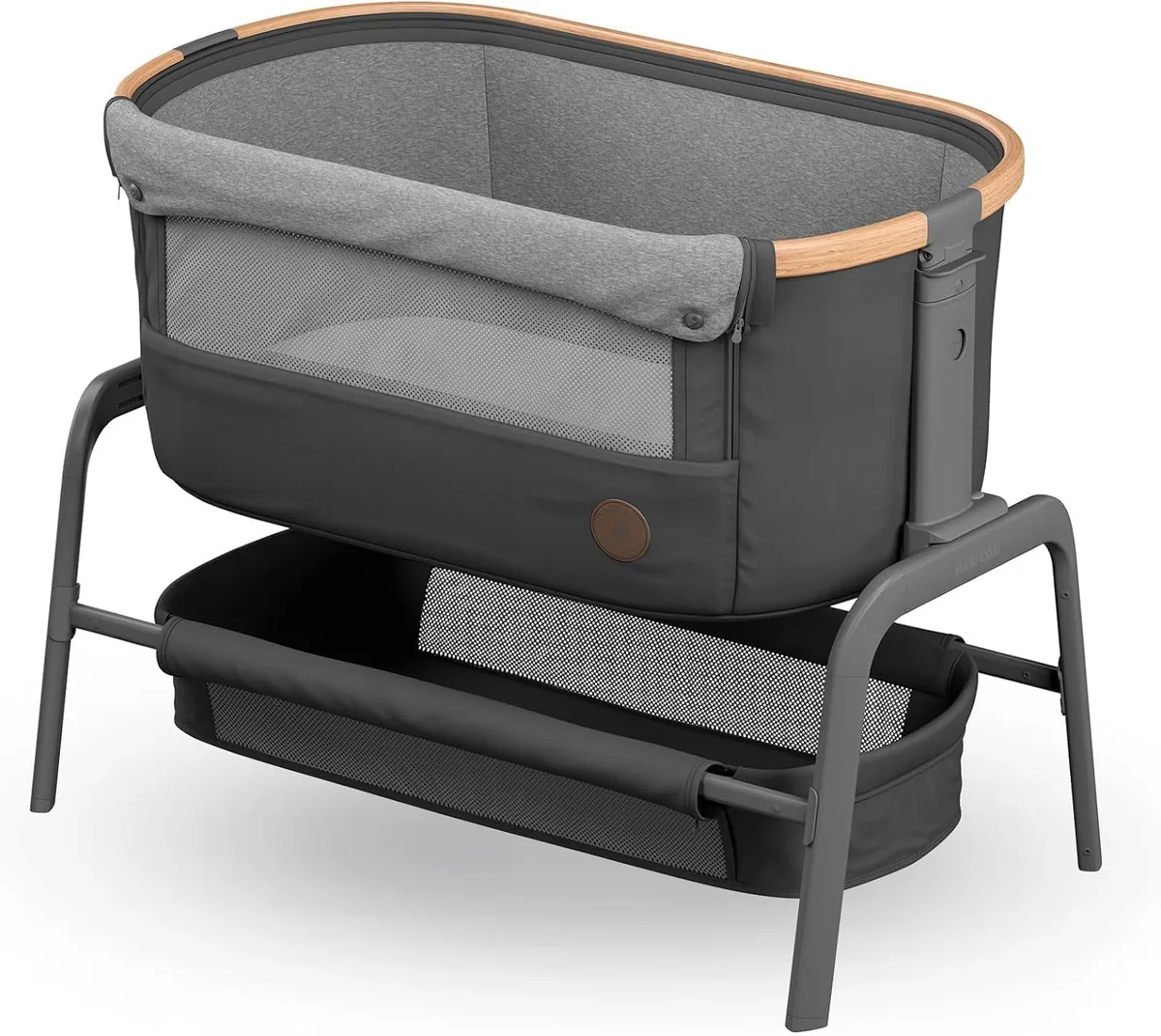
Bedside crib, incline and reflux: what you need to know
Many bedside cribs, including the Maxi-Cosi Iora, let you tilt the sleep surface, often with reflux as the selling point. Sleep recommendations, on the other hand, call for a flat sleep surface. Here is how to reconcile the two.
Contents
Our position in brief
Flat by default. Lay baby flat on their back, on a flat sleep surface. Only use an incline if your paediatrician or GP recommends it, and strictly following the manufacturer’s instructions.
This position is not a criticism of the Maxi-Cosi Iora, which we recommend elsewhere. It follows from the official recommendations on infant sleep, which make no exception for reflux without medical advice.
What the recommendations say
In France, sante.fr reminds parents that to prevent the risk of sudden unexpected infant death and support healthy motor development, baby must always be laid flat on their back on a firm mattress. In the United States, the National Institutes of Health leaflets describe a safe sleep surface as firm, flat and level, and specify that it should not be inclined. In the UK, the NHS also advises putting baby to sleep on their back on a firm, flat mattress. These sources agree: the recommended sleep surface is flat.
These recommendations apply to all healthy babies, including those who spit up. Only a doctor can suggest a different position for a particular child, based on their medical situation.
Why flat?
On an inclined surface, an infant can slide down the sleep space, curl up or turn their head into a position that restricts breathing. Very young babies are not yet strong enough to free themselves. A flat, firm surface limits these risks. This is why health authorities have warned against inclined infant sleep products in recent years.
People often think that a baby lying flat on their back could choke if they spit up. Health authorities explain that, on the contrary, healthy babies lying on their back have reflexes that protect them, and that the back position does not increase this risk. Your GP, midwife or health visitor can explain this to you.
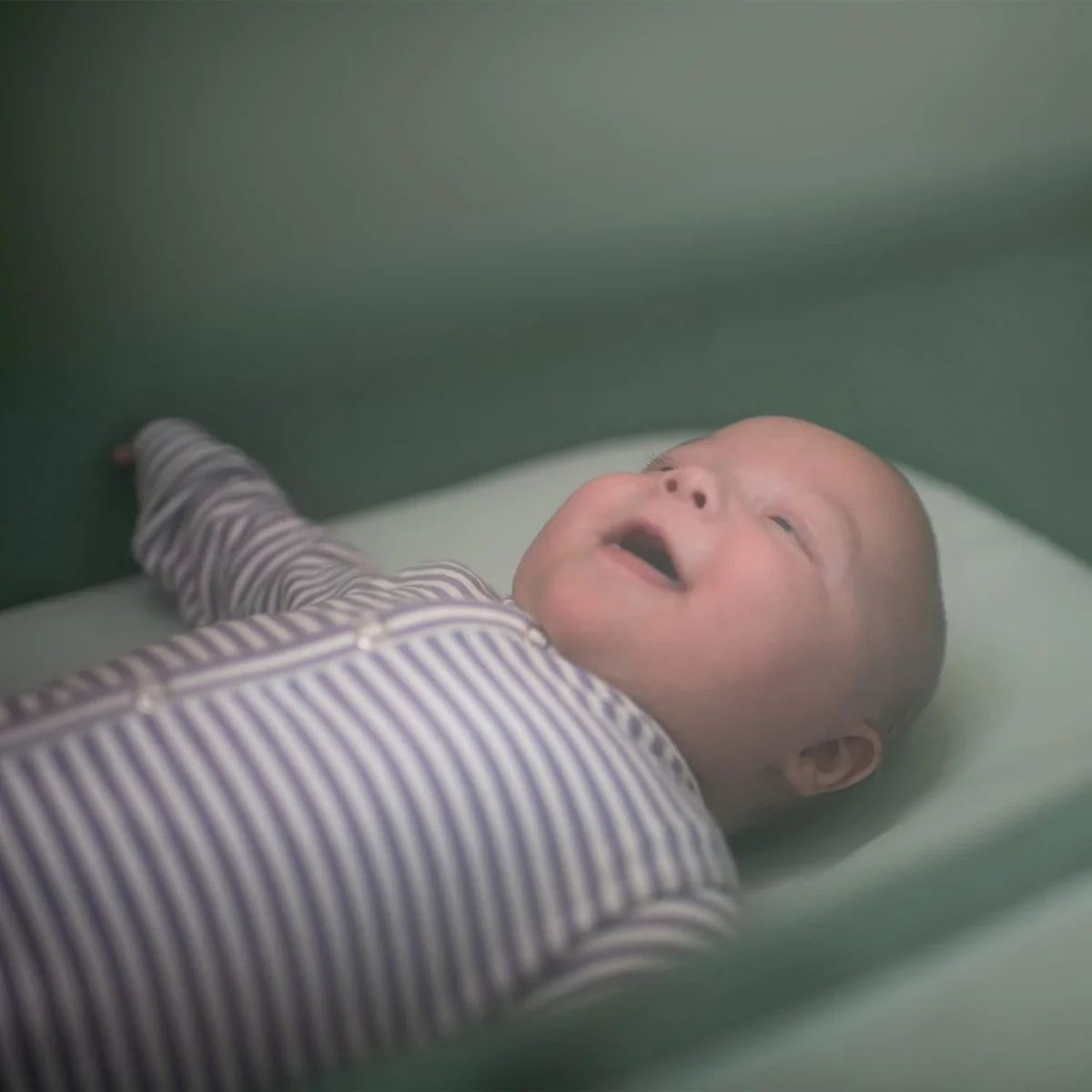
Why manufacturers offer an incline
Manufacturers respond to demand. Many parents of newborns worry about spit-up and look for a way to reduce it. Maxi-Cosi thus presents the Iora’s four incline positions as a way to minimise reflux, and several parents’ reviews cite this feature as a reason for buying.
The presence of a feature on a product does not mean it should be used all the time. The instructions may specify conditions of use, a maximum angle or a duration. Read them, and talk to your doctor before any use.
Infant reflux
Spit-up is very common in babies. Their stomach is small, the muscle that closes the top of the stomach is still immature, and they drink a lot relative to their size. A baby who brings up a little milk after a feed, but grows well, gains weight and seems comfortable, most often has ordinary reflux, which improves with time.
It is not for a product page, or a site like ours, to make a diagnosis. If spit-up worries you, talk to your GP, paediatrician or health visitor. They can assess the situation and suggest suitable measures if needed.
Spit-up, reflux, GORD: the words
Several words are used for the same family of symptoms, which can be confusing. “Spit-up” or “posseting” describes the small amounts of milk that many babies bring up after a feed. Doctors often call this reflux, meaning that milk travels back up from the stomach: in most babies it is a normal, harmless phenomenon linked to an immature digestive system. Gastro-oesophageal reflux disease, often shortened to GORD, is something else: a term doctors use when reflux causes problems, such as pain, feeding difficulties, poor weight gain or breathing symptoms. Only a doctor can tell the difference, after examining baby and looking at their growth. If you read about “reflux” on a product box or in a forum, remember that this word alone says nothing about your baby’s situation. And whatever the word, the recommendation for sleep stays the same unless your doctor says otherwise: on the back, on a flat surface.
When to see a doctor
Seek medical advice quickly if baby:
- vomits forcefully or repeatedly;
- vomits blood or green fluid;
- refuses to feed, or is not gaining weight well;
- seems to be in pain during or after feeds, cries a lot, arches their back;
- coughs, chokes or has difficulty breathing;
- has a fever, is unusually floppy or hard to wake.
If there are signs of distress, call 999 or 112.
The Maxi-Cosi Iora’s positions
The Iora offers four incline positions for the sleep surface. Our advice on using them is simple:
- Set up and use the Iora in the flat position by default, for every night and every nap.
- If your doctor recommends an incline, ask which one, for how long and under what conditions.
- Follow Maxi-Cosi’s instructions strictly for the adjustment.
- Check that in the inclined position, the sleep surface stays correctly positioned in relation to your bed, with no gap.
- Go back to the flat position as soon as medical advice no longer calls for the incline.
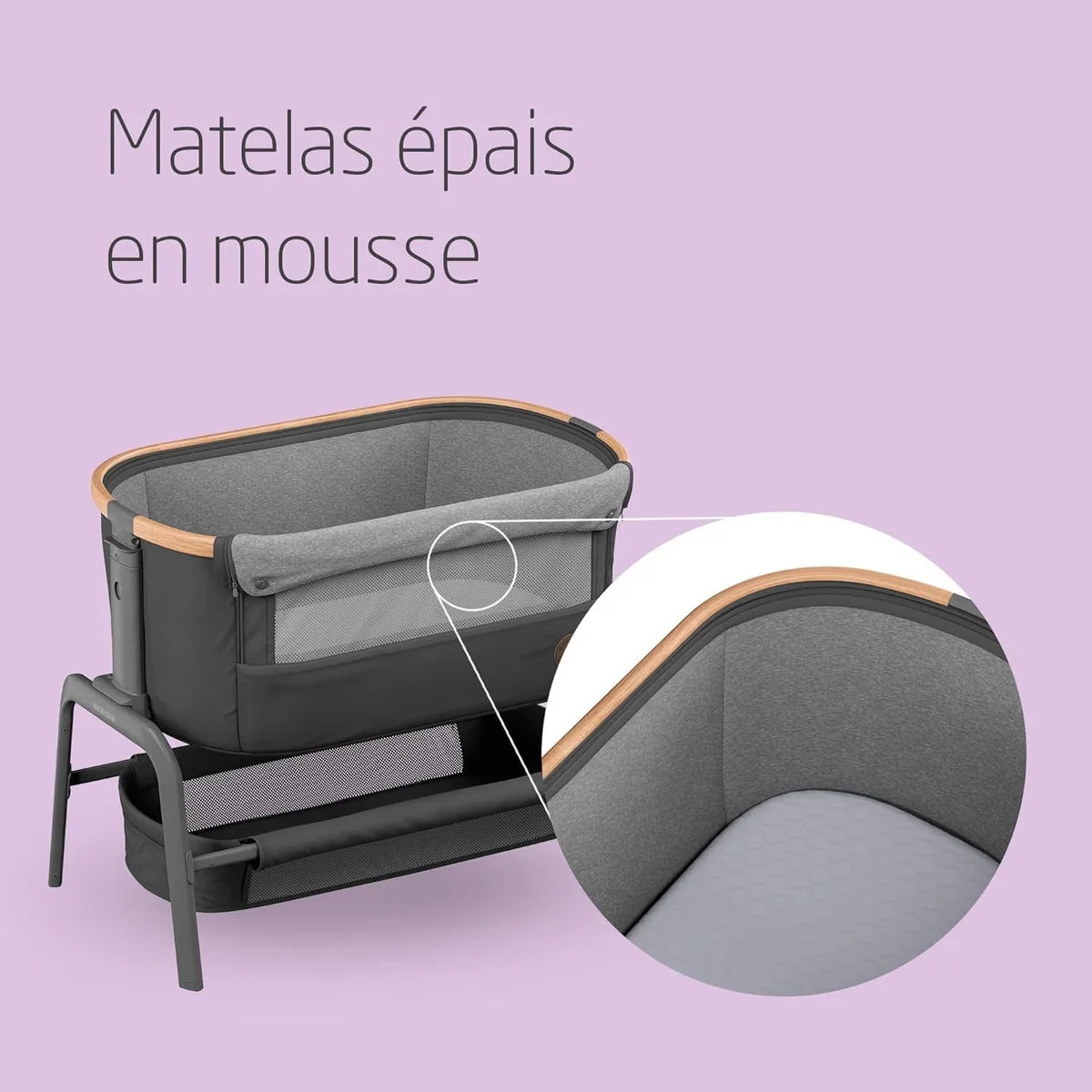
The rest of the Iora, its height settings, sliding system, mattress and mesh, does not depend on the incline. Our review covers each feature.
Things that help without tilting
Several simple measures, often recommended by health professionals, can help a baby who spits up without touching the sleep surface:
- holding baby upright against you for a while after the feed;
- winding baby calmly during and after the feed;
- avoiding sudden movements just after the feed;
- avoiding clothes or nappies that are too tight around the tummy;
- for bottle feeding, asking for advice on the amount, the teat and the pace.
These tips are general. Your GP, midwife or health visitor can adapt them to your baby.
Ideas that seem good but are not
- Slipping a cushion, a rolled towel or a book under the mattress.
- Using a wedge or a positioner to keep baby on their side.
- Putting baby to sleep on their tummy to reduce spit-up.
- Letting baby sleep in a bouncer, a car seat or on a breastfeeding pillow.
- Using the incline every night without medical advice.
Inclined sleep products: a closely watched issue
The question of incline is not limited to bedside cribs. In recent years, several product safety authorities, particularly in North America, have warned against inclined sleep products for infants and have had some products withdrawn from the market after serious accidents. These products were often sold on the strength of reflux or comfort. The US health leaflets draw a simple rule from this: a safe sleep surface is flat.
A bedside crib that offers an incline setting is not, for all that, an “inclined product” in the sense of these warnings: its sleep surface can be used flat, and in Europe it is covered by the EN 1130 standard. That is precisely why we recommend the flat position by default. The feature exists and may help on medical advice, but it should not become the usual position.
Preparing for the doctor’s appointment
If baby’s spit-up worries you, note down a few details before the appointment. They will help the doctor assess the situation:
- Frequency: after how many breastfeeds or bottles does baby spit up, and how long after the feed?
- Amount: a few mouthfuls, or most of the feed?
- Appearance: milk, curdled milk, any blood or green fluid?
- Behaviour: does baby seem comfortable, or cry, arch their back, refuse to drink?
- Growth: bring the red book with the recorded weights.
- Sleep: what does baby sleep in, in what position, with what settings?
Use the appointment to ask about the sleep surface: should it be inclined? If so, by how much and for how long? The doctor knows your baby and can give you a precise answer. If needed, show them the Iora’s instructions and its positions.
If an incline is recommended
If your doctor recommends an incline, a few checks are essential. Set the incline exactly as the instructions describe, without adding a wedge or cushion. Check that baby stays in the middle of the mattress, on their back, without sliding down or curling up. Make sure the sleep surface stays correctly positioned in relation to your bed, with no gap between the two surfaces, just as in the flat position. Keep using the sleeping bag, which limits leg sliding, and put nothing else in the crib.
Keep an eye on the duration too. An incline recommended for a given period should not continue out of habit. Ask the doctor when to go back to flat, and do so as soon as possible.
Reflux during the day
Spit-up is not limited to the night. During the day, many parents notice that baby spits up more when lying down just after a feed, or when jiggled. Carrying baby upright against you after the feed is often appreciated. Tummy time, awake and supervised, is also recommended for baby’s development, but it is best done away from feeds. Bouncers and car seats are not places to sleep: if baby falls asleep in one, move them to the crib, flat on their back.
Reflux changes with age
For the vast majority of babies, spit-up decreases over the months, as the digestive system matures and baby spends more time sitting up. This often happens just as baby leaves the bedside crib, around 4 to 6 months. The cot that takes over is a flat sleep surface with no incline: a good opportunity to confirm with the doctor that the flat position suits baby. Our article moving on from a bedside crib helps you prepare for this step.
What parents say about the Iora’s incline
In published reviews, the Iora’s incline often comes up as a reason for buying, especially among parents of babies who spit up. We understand that expectation. But a customer review describes one family’s experience, not a health recommendation. Our review summary takes this into account: we praise the comfort of the mattress and the versatility of the crib, and we stand by our advice to use the flat position by default.
The essentials in five points
- The recommended sleep surface for baby is flat, on the back, on a firm mattress.
- A bedside crib’s incline is for use on medical advice only, following the instructions.
- Spit-up is common and usually harmless.
- Certain signs call for prompt medical advice.
- No wedge, cushion or positioner in the crib.
Myths about reflux and sleep
“A baby who spits up should sleep on their side”
No. The recommendations call for sleeping on the back. On their side, baby can roll onto their tummy, a position advised against for sleep.
“The more incline, the better”
No. A steep incline increases the risk of baby sliding or curling up. Only a doctor can suggest an incline, within the limits set by the manufacturer’s instructions.
“Reflux stops baby sleeping”
Not necessarily. Many babies spit up without it disturbing their sleep. If baby seems to be in pain or sleeps very badly, talk to your doctor.
“A separately sold anti-reflux mattress is safer”
No. Only use the mattress supplied with the bedside crib, flat. Do not add an inclined wedge, a positioner or a cushion.
What about other bedside cribs?
Many bedside cribs on the market offer some form of incline, with settings that differ from one model to another. The advice is the same whatever the model: flat by default, incline only on medical advice, and always following the instructions. It is not a criterion that should guide your purchase. Compatibility with your bed, a firm mattress and a secure attachment matter far more. See our guide how to choose a bedside crib.
Talking about the incline with family
Grandparents or friends may advise you to raise the head of the crib, as was often done in the past. The recommendations have changed, and sleeping flat on the back is now the rule. Simply explain that you are following the advice of health authorities and your doctor. If someone else puts baby to bed, check with them that the bedside crib’s sleep surface is in the flat position and that no wedge or towel has been slipped under the mattress.
A typical night with a baby who spits up
After the feed, hold baby upright against you for a few minutes, long enough for a burp. If needed, change baby before the feed rather than after, to avoid handling them on a full stomach. Then lay baby back in the crib, on their back, on a flat surface. If baby spits up while asleep, simply wipe their mouth with a muslin, change the fitted sheet if necessary using the spare set kept in the basket, and lay baby back down on their back. Keep one or two spare bodysuits within reach. If the spit-up is heavy or worries you, note it down to discuss with your doctor.
Frequently asked questions
Is a bedside crib’s incline dangerous?
The recommendations call for a flat sleep surface. We advise using the flat position by default and an incline only on medical advice, following the instructions.
Can a baby who spits up sleep flat?
Yes, according to the recommendations, on their back and flat. Talk to your doctor if you are worried.
How many positions does the Iora have?
Four positions according to Maxi-Cosi. Use the flat position by default.
Should I choose a bedside crib with an incline?
It is not a priority criterion. Compatibility with your bed and a firm mattress matter more.
Ready for those first nights?
2-in-1 bedside crib · 0 to 6 months · Up to 9 kg · Travel bag. Prices and colours change often on Amazon: check them, along with the seller, the exact model (Iora, Iora Air, Iora Plus…) and whether it fits your bed, before ordering.
Check the price on AmazonAffiliate link · new tab