Moving from a bedside crib to a cot
A bedside crib is only used for a few months. The day baby leaves it comes quickly, sometimes sooner than you expect. Here is how to spot that moment and organise the move to a cot without turning your nights upside down.
Contents
When should you stop using the bedside crib?
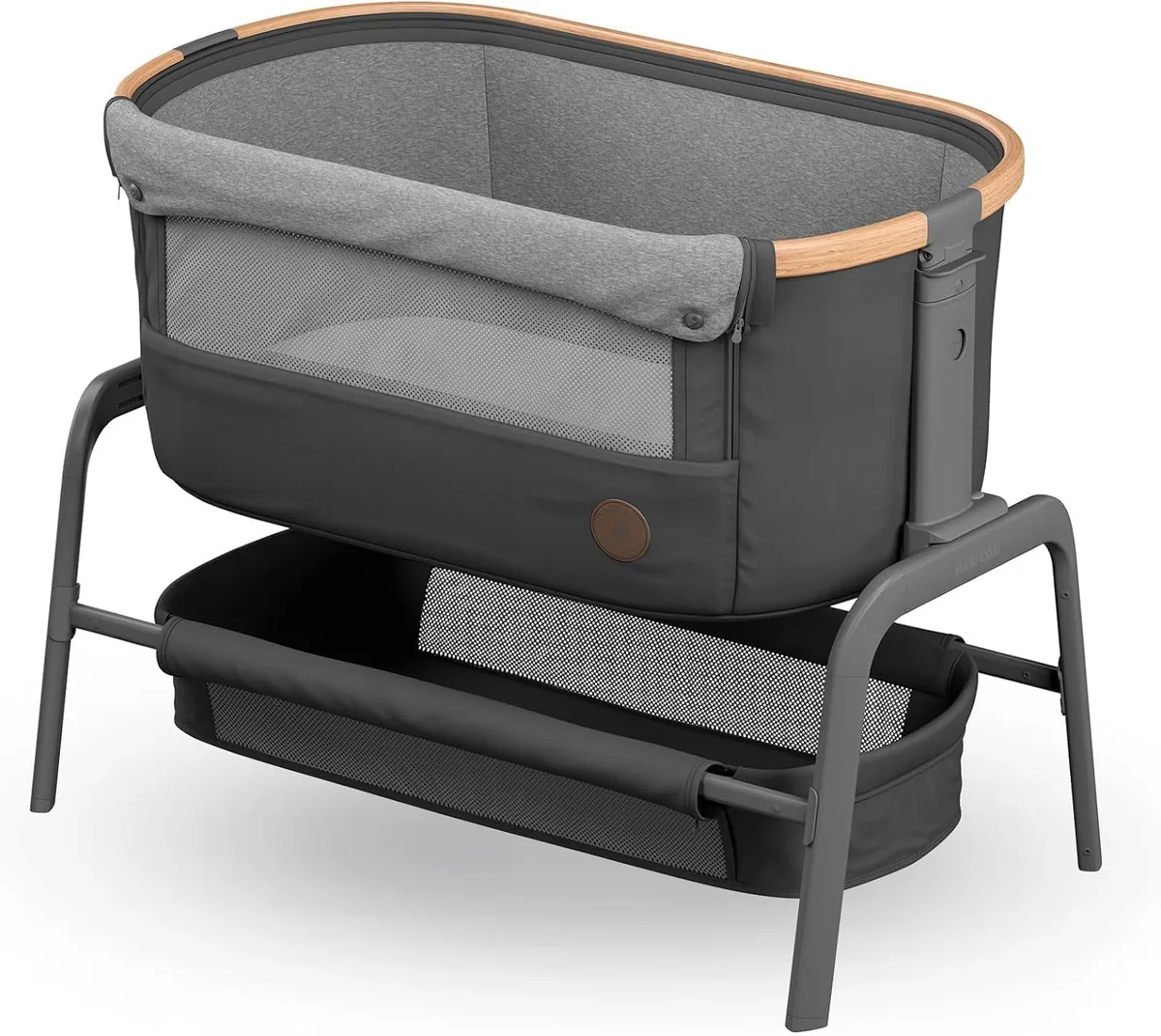
Every bedside crib has its limits, set by the manufacturer. The Maxi-Cosi Iora is stated for use from birth to around 6 months, up to 9 kg. The EN 1130 standard, which covers cribs and bedside cribs, applies to infants until they can sit up, kneel or pull themselves up unaided. For another model in its range, Maxi-Cosi asks parents to move to a bigger bed as soon as baby can sit up, roll over or pull up unaided.
The practical rule is therefore simple: the first limit reached is the one that counts. If baby reaches 9 kg at 5 months, you stop. If baby rolls over at 4 months, you stop, even at 7 kg. If baby reaches 6 months without rolling over or going past 9 kg, it is also time to move on. This is why many babies leave their bedside crib between 4 and 6 months. Our calculator shows you where you stand.
Why these limits? A bedside crib is a crib: its sides are low and its surface is small. A baby who rolls over, sits up or kneels can tip over an edge, get stuck against a side, or move towards the edge of the parents’ bed. A crib is not designed for a child that mobile. A cot, larger and with higher sides, is.
The signs that leave no doubt
- Baby rolls over, from back to front or front to back, even just once.
- Baby starts to sit up, even with support.
- Baby gets onto their knees or pushes up to pull themselves upright.
- Baby reaches the manufacturer’s weight limit.
- Baby touches both ends of the crib, or regularly bumps against the sides.
- Baby reaches the stated age limit.
These milestones sometimes arrive overnight. Once they are reached, do not put the change off “until next week”: have the cot ready before you need it.
Planning ahead from the day you buy
The short life of a bedside crib should be part of your plan from the start. Even before the birth, decide where baby will sleep next and which cot you will use. Some families buy or borrow the cot at the same time as the bedside crib and set it up in the child’s room so it is ready when the time comes. Others prefer to wait, but keep in mind that the transition may come at 4 months.
Choosing the cot
A cot with bars, often 60 x 120 cm, is the natural next step after a bedside crib. It is generally used until 2 or 3 years. Choose a compliant model with a height-adjustable base, which you will set to the low position as soon as baby can sit up, following the instructions. The mattress must be firm and the exact size of the cot, with no gaps at the sides. The same sleep rules apply: baby on their back, in a sleeping bag, with no pillow, duvet, bumper or soft toy.
Some cots are convertible and later become a toddler bed. Others have a removable side and can be placed against the parents’ bed, like a bedside crib: their compatibility conditions then need checking with the same care.
In your room or theirs?
Leaving the bedside crib does not necessarily mean leaving your bedroom. The French public health site Sante.fr describes room sharing as protective before 6 months, and the NHS likewise advises keeping baby in your room for the first 6 months. If baby leaves the bedside crib at 4 months, you can put the cot in your room for the following weeks, if there is space. Other families use this moment to move baby into their own room, often after 6 months.
There is no single right answer. It all depends on the space you have, your nights, breastfeeding and what you want. What matters is that the new sleep space is safe and that the transition happens calmly.
The transition, step by step
- Set up the cot in advance, a few days before the change, so you get used to the new layout.
- Start with naps: put baby down in the new cot for one or two naps a day. Baby discovers this new space at a calm moment.
- Raise the side of the bedside crib for a few nights before the change, if baby has not yet reached a limit. Baby gets used to a little distance.
- Move to nights in the cot, keeping exactly the same bedtime routine.
- Stay available: in the first nights, baby may wake more. Reassure baby with your voice and hand, in the new cot.
If baby has already reached a limit, skip the raised-side step: the change has to happen straight away. A crib, even with the side raised, is no longer suitable for a baby who rolls over or sits up.
Keeping the routines
What reassures baby is familiarity. Keep the same bedtime routine: the nappy change, pyjamas, the same sleeping bag, the breastfeed or bottle, the song, the cuddle. Keep the same night light and the same atmosphere in the room. If you can, put the cot where the bedside crib was, or at least in the same room to begin with. The fewer changes at once, the gentler the transition.
If the nights get harder
Some transitions go smoothly, others take a few days or a few weeks. Baby may cry more at bedtime and wake more often. It is often temporary. Stay consistent as parents, reassure baby in the new cot rather than bringing them into your bed, and be patient. If the nights become very hard or you are exhausted, talk to your GP, health visitor or midwife. Do not go back to the bedside crib if baby has gone past its limits.
What to do with the bedside crib afterwards
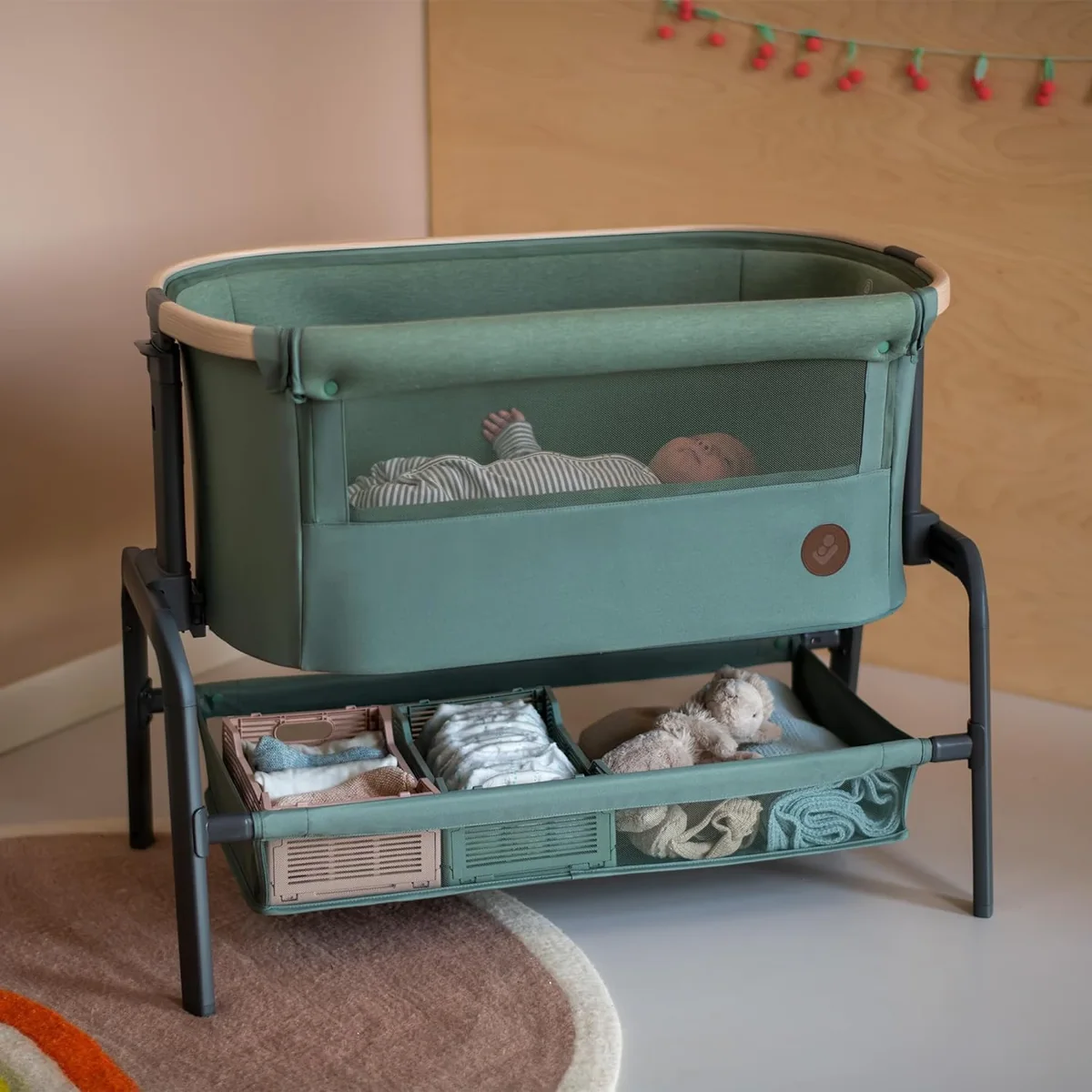
Once baby has moved to a cot, the bedside crib can be stored for a future child, lent or sold. Clean the fabrics following the manufacturer’s instructions, let them dry completely, check every part, and store the crib folded in its bag, somewhere dry. For the Iora, Maxi-Cosi states that the inner fabrics of the crib and the basket unzip and can be machine washed according to the label. If you lend or sell it, include the instructions and point out the compatibility conditions and the age and weight limits.
If a new baby arrives, check the condition of the mattress, the mesh and the mechanisms before using the bedside crib again, and measure again if you have changed bed in the meantime.
What you see around 4 to 6 months
Between 4 and 6 months, many babies make rapid progress in movement. They push up on their arms when lying on their tummy, roll onto their side, then roll over. Some begin to sit with support. These milestones do not follow a precise calendar: every child moves at their own pace. That is why the age shown on a bedside crib is a guide, not a guarantee. Watch your baby during awake time: if baby starts rolling on the play mat, it will soon happen in the crib too.
Weight goes up as well. A baby born at around 3.3 kg often doubles their birth weight at around 4 to 5 months, according to common reference points, with big differences from one child to another. The Iora’s 9 kg limit can therefore be reached before 6 months in a baby who grows quickly. Weigh baby regularly, or check the weights recorded in their personal child health record (the “red book”).
The crib with the side raised: an in-between step?
Some parents use the bedside crib with the side raised for a few nights, to create a little distance before the big change. This is only possible if baby has not yet reached any limit: not the maximum weight, not the age, not the movement milestones. As soon as baby rolls over or sits up, the crib is no longer suitable, with the side lowered or raised. Do not drag this step out longer than is reasonable.
The new sleep space, point by point
- The cot: a compliant, stable cot with an adjustable base.
- The base: in the high position as long as baby cannot sit up, then in the low position, following the instructions.
- The mattress: firm, the exact size of the cot, with no gaps at the sides.
- The sheet: a fitted sheet in the right size, pulled tight.
- The sleeping bag: suited to baby’s new size and to the season.
- Nothing else: no pillow, duvet, bumper or soft toy.
- The position: away from windows, radiators, blind cords and furniture baby could later climb on.
The nights after the transition
When baby moves to the cot, you are no longer within arm’s reach. Night feeds mean getting up. For mothers still breastfeeding at night, putting the cot in the parents’ room, as close as possible, limits the trips back and forth. A comfortable chair next to the cot can help too. If baby sleeps in their own room, a baby monitor can reassure you, as long as the unit and its cable are out of reach of the cot.
In the first nights, it is normal for baby to wake a little more, and for you to sleep less well too. Parents who have used a bedside crib are often surprised to miss that closeness. Give yourself a few days to adjust.
A little brother or sister on the way
If you plan to use the bedside crib again for another child, store it carefully. Wash the fabrics according to the label, let them dry completely, check the mesh and the mechanisms, and keep the instructions in the bag. Note the purchase date for the warranty. Before reusing it, redo the whole setup and the push test on the parents’ bed, especially if you have changed bed or mattress in the meantime.
Lending or selling the bedside crib
A bedside crib in good condition often interests other families. If you lend or sell it, include the instructions, mention any worn parts, and point out the model’s compatibility conditions: for the Iora, a bed with a total height of at least 56 cm, a frame of 30 to 49 cm and a gap of no more than 5.5 cm between the frame and the mattress. State the age and weight limits too. A well-informed buyer will use the bedside crib in the right conditions.

The transition checklist
- I have noted baby’s current weight and the bedside crib’s limit.
- I watch baby’s movement progress during awake time.
- The cot is chosen, assembled and in place before it is needed.
- The mattress is firm and the exact size of the cot.
- The fitted sheets and sleeping bag are the right size.
- The bedtime routine stays the same.
- The first naps take place in the new cot.
- The bedside crib is cleaned, checked and stored with its instructions.
Choosing the right moment
When baby has reached a limit, there is no choosing: the move happens straight away. But if you are planning the switch a little ahead, for example because baby is approaching 9 kg or starting to roll on the play mat, you can pick a calmer moment. Avoid, if you can, making the change on the same days as another upheaval: a cold or a vaccination, a trip away, a house move, a return to work, a new childminder or nursery. Baby copes better with one change at a time, and so do you. A quiet week at home, with both parents available for the first nights, is ideal. If such a week is not in sight, do not wait for it at the expense of safety: a cot set up in advance, with the same routine, will make the transition easier whatever the timing.
A change for parents too
People talk a lot about baby adapting, less about the parents. After several months of hearing baby breathe a few centimetres away, seeing them sleep a little further off can be unsettling. Some parents wake up to check baby is all right, others finally sleep more deeply. Both reactions are normal. If worry keeps you from sleeping for a long time, talk to your GP or health visitor. Moving to a cot is one more step in a first year full of changes, and it usually goes well.
Bear in mind as well that baby’s nights will not be perfect overnight. Teething, colds, new motor skills: sleep goes up and down throughout early childhood. A cot, larger and with higher sides, gives a sleep space suited to a child who moves more and more.
The key points
A bedside crib accompanies the first months, those with the most frequent wake-ups. It ends at the first limit reached: 9 kg, around 6 months, or the first roll, the first time sitting up. Prepare the cot in advance, start with naps, keep the same routines and stay available in the first nights. Nothing says you have to leave the parents’ room at the same time as the bedside crib.
Frequently asked questions
At what age should you stop using a bedside crib?
Around 6 months for the Iora, or earlier as soon as baby reaches 9 kg, rolls over, sits up or pulls up unaided.
My 3-month-old rolls over: should I stop?
Yes. Movement milestones take priority over age and weight.
Can I keep using the crib with the side raised for longer?
No, if baby has reached a limit. The crib is no longer suitable for a mobile baby.
Should baby move to their own room?
Not necessarily. The cot can stay in your room, especially before 6 months.
Ready for those first nights?
2-in-1 bedside crib · 0 to 6 months · Up to 9 kg · Travel bag. Prices and colours change often on Amazon: check them, along with the seller, the exact model (Iora, Iora Air, Iora Plus…) and whether it fits your bed, before ordering.
Check the price on AmazonAffiliate link · new tab