Bedside crib, Moses basket or cot: which to choose?
For the first months, several sleeping spaces are equally safe, provided they are compliant and used correctly. They are not equal on everything else: duration, space, nights. Here is how to decide.
Contents
What all these sleeping spaces have in common
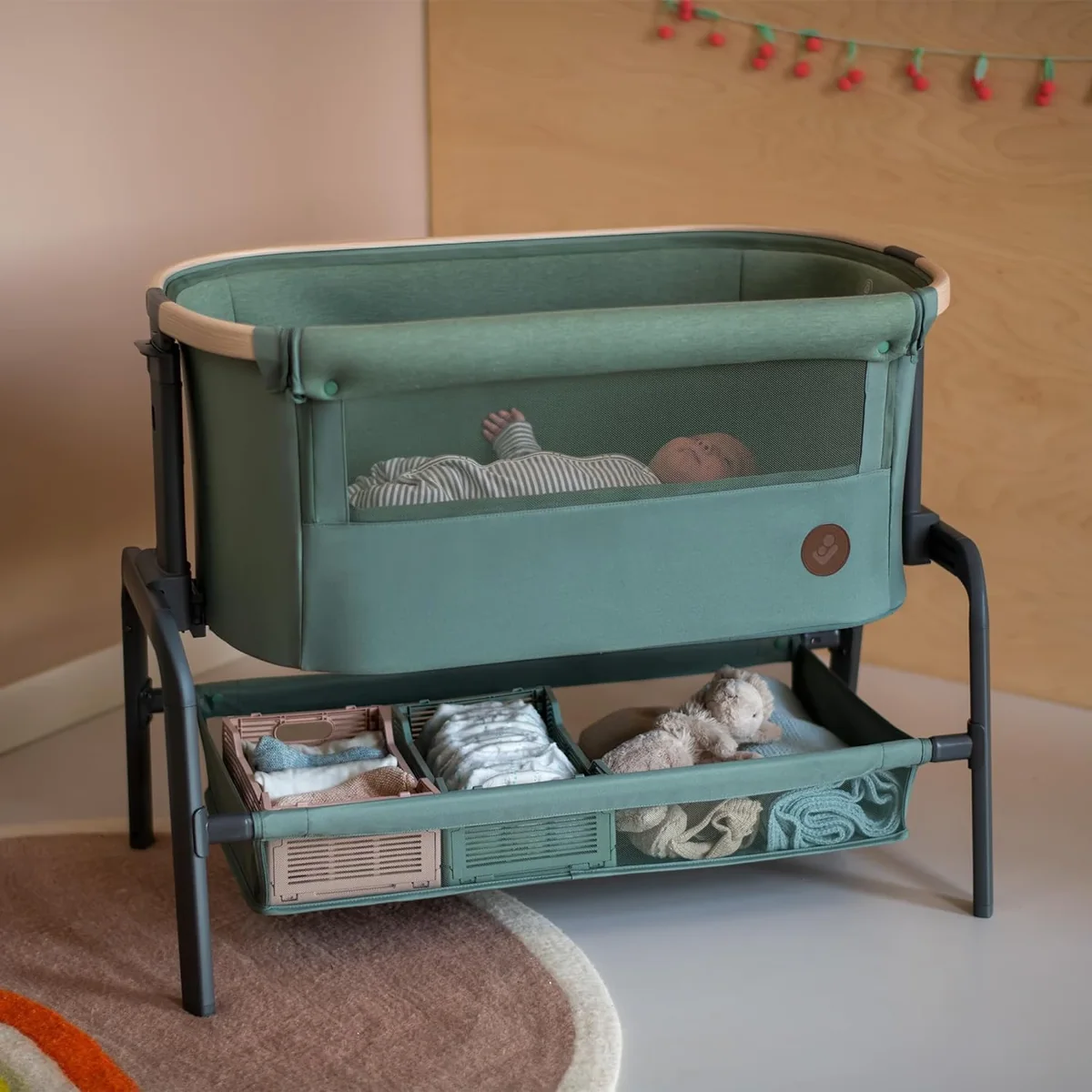
Before comparing, let us recall what does not change. Whatever sleeping space you choose, the rules of infant sleep are the same. Sante.fr, the French public health website, recalls that a baby must be put to sleep flat on their back, on a firm mattress, and that room sharing before 6 months is a protective factor. The crib can be placed against the parents’ bed for the first months. In the sleeping space there is only a suitable firm mattress, a fitted sheet, and the baby in a sleeping bag. No pillow, duvet, bumper or soft toy.
So what sets sleeping spaces apart is not that one is safe and the other is not: it is how they are used. How long do they last? How much space do they take? Do they make nights easier? Can they be moved? These are the questions your choice depends on.
The comparison in one table
| Sleeping space | Typical period of use | Space | Night feeds | Mobility |
|---|---|---|---|---|
| Bedside crib | Up to about 6 months | Medium, along the bed | Very easy, baby within arm’s reach | Depends on the model, often folding |
| Standard crib | A few months | Medium | You have to sit up or get up | Sometimes on wheels |
| Moses basket, carrycot | A few weeks to a few months | Small | You have to get up | Very mobile |
| Cot with bars | Up to 2 to 3 years | Large | You have to get up | Low |
| Travel cot | Up to 2 to 3 years depending on the model | Medium to large | You have to get up | Folding, made for travel |
The durations are indicative: each model has its own age and weight limits, and your baby’s motor skills often decide before the calendar does.
The bedside crib
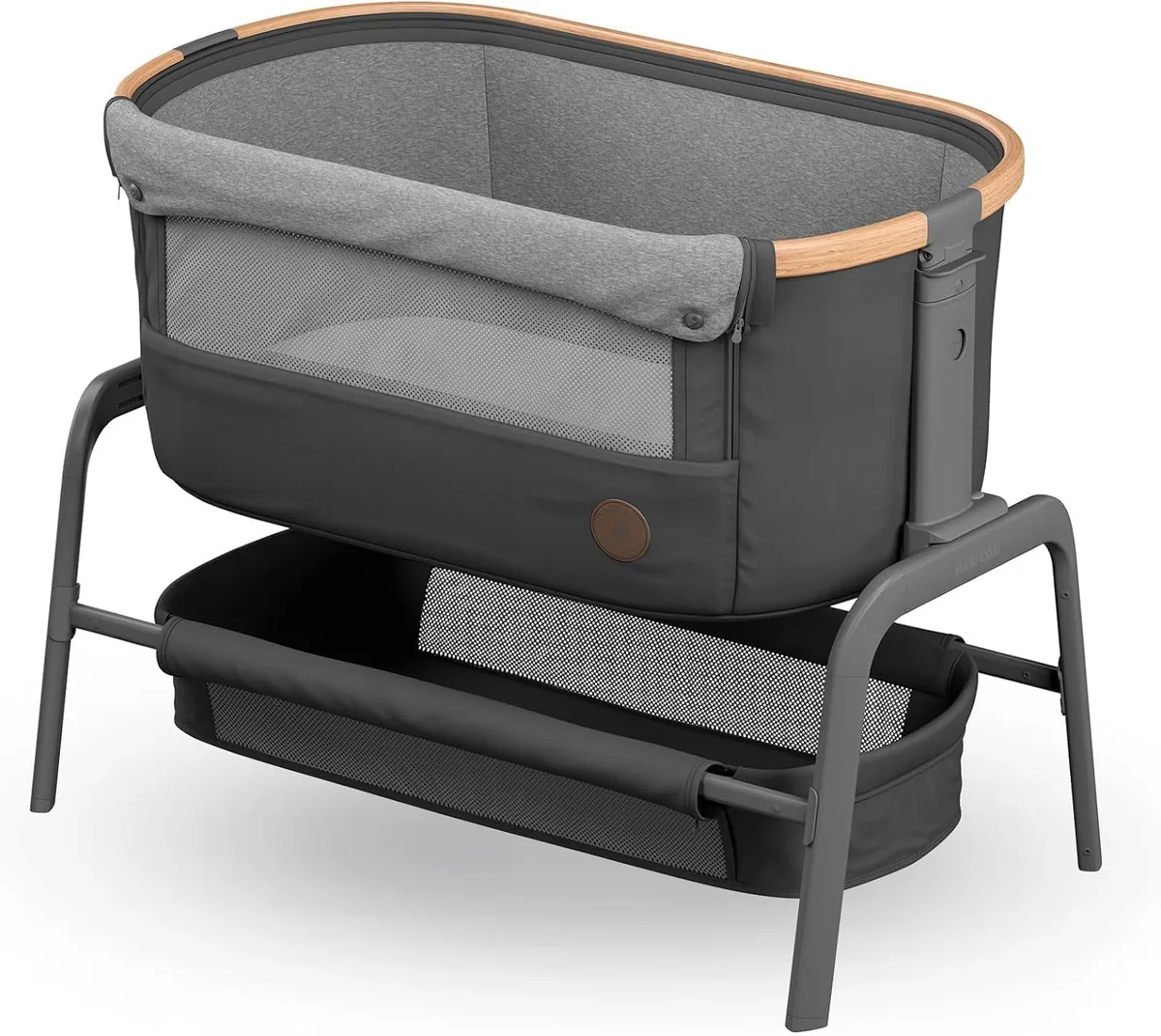
A bedside crib is a crib with one side that lowers so it can sit against the parents’ bed. Its great strength is the nights: your baby is within arm’s reach, you see and hear them without sitting up, you can pick them up for a feed and put them back without leaving your bed. For breastfeeding mothers or those recovering from a caesarean, this is often decisive.
Its limitations are well known. It only lasts a few months: the Maxi-Cosi Iora is announced up to about 6 months and 9 kg, and you must stop as soon as the baby rolls over, sits up or pushes up unaided. It must fit your bed: the Iora requires a total height of at least 56 cm, a frame of 30 to 49 cm and a gap of no more than 5.5 cm between the frame and the mattress. And it must be set up with no gap at all, which takes a little rigour. Not all authorities approve of it: Health Canada advises against products attached to an adult bed. In Europe, it is covered by EN 1130.
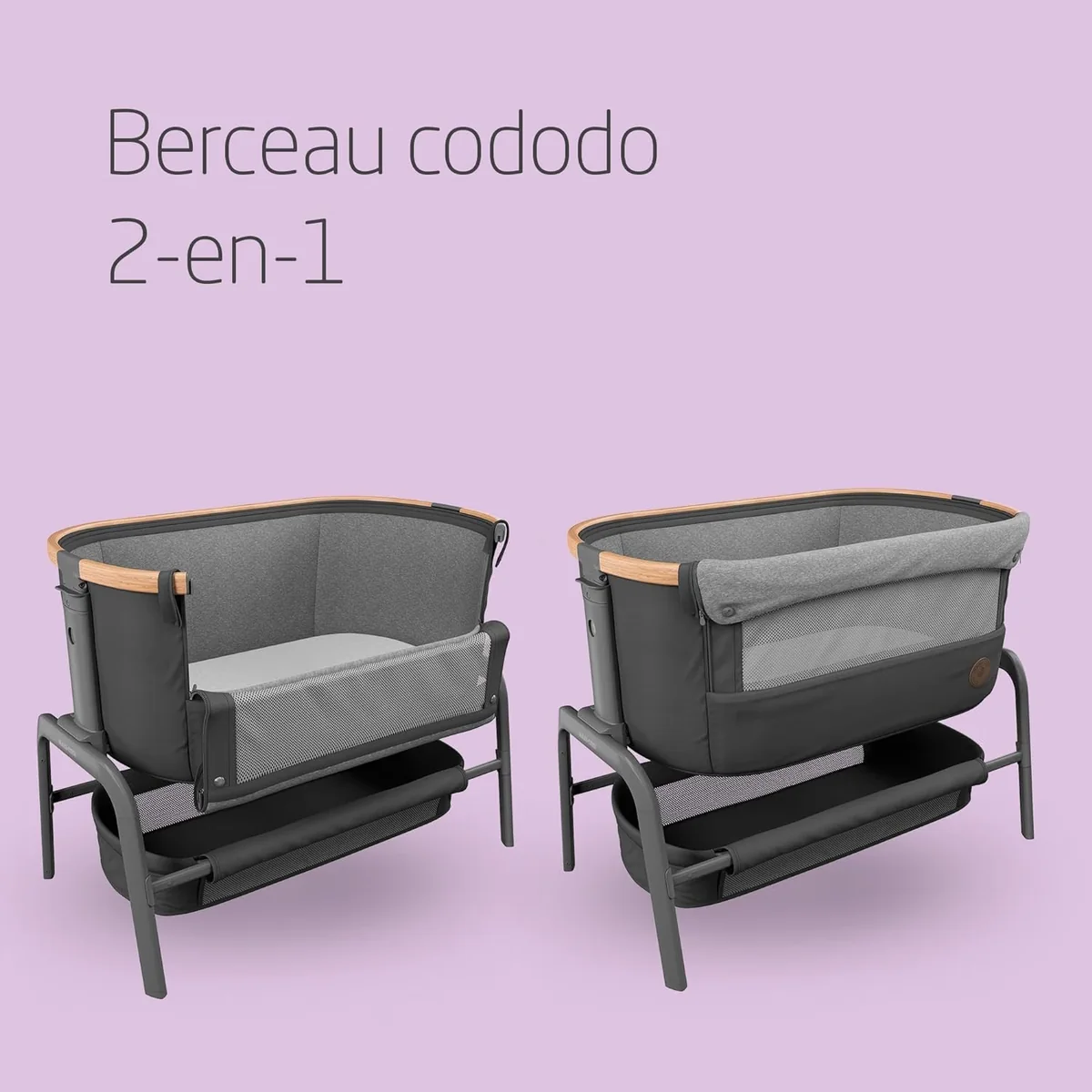
Many bedside cribs are 2-in-1: with the side up, they become a standalone crib. This is the case with the Iora, which also works for naps in the living room. See our Maxi-Cosi Iora review.
The standard crib
A crib on legs, fixed or rocking, goes next to your bed or elsewhere in the room. It has no drop-down side: to pick up your baby at night, you have to sit up, or even get up. On the other hand, it has no compatibility conditions with your bed, and it can go wherever you like. It lasts about as long as a bedside crib. It is a good solution if your bed is not compatible with a bedside crib, or if you prefer a little distance between the two sleeping spaces. Cribs are also covered by EN 1130.
The Moses basket and carrycot
The Moses basket and the pram carrycot are very light sleeping spaces that are easy to move. They are often used in the first weeks, or for daytime naps. They last a very short time, and they must be placed on a stable surface, on the floor or on a stand provided by the manufacturer, never on a bed or a sofa. For a pram carrycot, check that the manufacturer approves it for overnight sleep.
The cot with bars
The cot, often 60 x 120 cm, is the sleeping space that lasts longest: up to 2 or 3 years, sometimes more for convertible models. It can be used from birth, with its base in the high position for the first months, then lowered as soon as the baby can sit up. It can go in the parents’ room, in line with the room-sharing recommendation. Its drawback is space: it takes up much more than a bedside crib, and not every parents’ bedroom can fit one. And for night feeds, you have to get up.
Some cots have a removable side and can be placed against the parents’ bed, like a bedside crib. Their compatibility conditions must then be checked just as carefully.
The travel cot
A travel cot is a folding cot designed to be stored and carried. It often covers a long period, but its mattress is thin and it is designed for occasional use. Some models have a bassinet insert for the first months. It is a solution for trips and nights at the grandparents’, less often the main sleeping space of a newborn.
Combining two sleeping spaces
Many families combine two solutions. The most common pattern: a bedside crib for the first months, then a cot with bars at around 4 to 6 months, in the parents’ room or the child’s room. Another pattern: a cot from birth for the night, and a Moses basket or light crib for naps in the living room. A 2-in-1 bedside crib covers both uses on its own during its few months.
If your budget or space is limited, the simplest solution is a cot with bars set up in your room from birth. If nights are your priority, the bedside crib is the most comfortable, provided your bed is compatible. Our article moving from a bedside crib to a cot helps you organise the transition.
Which sleeping space for which profile?
- You are breastfeeding and want simple nights: bedside crib, if your bed is compatible.
- Your bed is an ottoman bed or a low bed: standard crib or cot in your room.
- You want a single purchase: cot with bars.
- Your bedroom is small: bedside crib or compact crib, then a cot in the child’s room.
- You travel a lot: folding bedside crib or travel cot, checking each host bed.
Questions to ask before deciding
If you are still hesitating, a few concrete questions usually settle it. How often do you expect to feed at night in the first weeks, and how easy is it for you to get up? Have you measured your bed, and does it meet the conditions of the bedside crib you are looking at? How much space is there next to your bed, and can a cot fit in your room or only in the child’s room? Do you want to use the same sleeping space for daytime naps, and in which room? How often will you sleep away from home in the first year? And would you rather buy once for three years, or accept two purchases for more comfortable first months? Write down your answers: the right sleeping space usually becomes obvious, and you avoid buying on impulse from a photo.
The budget over early childhood
To compare fairly, you need to think about the whole period when your baby sleeps in a cot, not just the first months. A bedside crib, a crib or a Moses basket lasts a few months, then you need a cot. A cot bought from birth is used on its own for two to three years. The bedside crib then cot combination therefore means two purchases, and two sets of sheets of different sizes. It is justified by the comfort of the first nights, which many families value highly.
To keep costs down, some families buy the bedside crib second-hand in good condition, or borrow one, and invest in a new cot. Others do the opposite. In every case, insist on a complete product, with its instructions and original mattress.
Space in the bedroom, tape measure in hand
Before choosing, measure the space available next to your bed. The Maxi-Cosi Iora takes up about 93 x 55 cm on the floor. A standard 60 x 120 cm cot takes up much more, not counting the thickness of the uprights. In a small parents’ bedroom, a cot can block a passage or a wardrobe door. The bedside crib slides along the bed, its base partly going under the frame. Also think about your path when getting up at night, and the other parent’s access on their side.
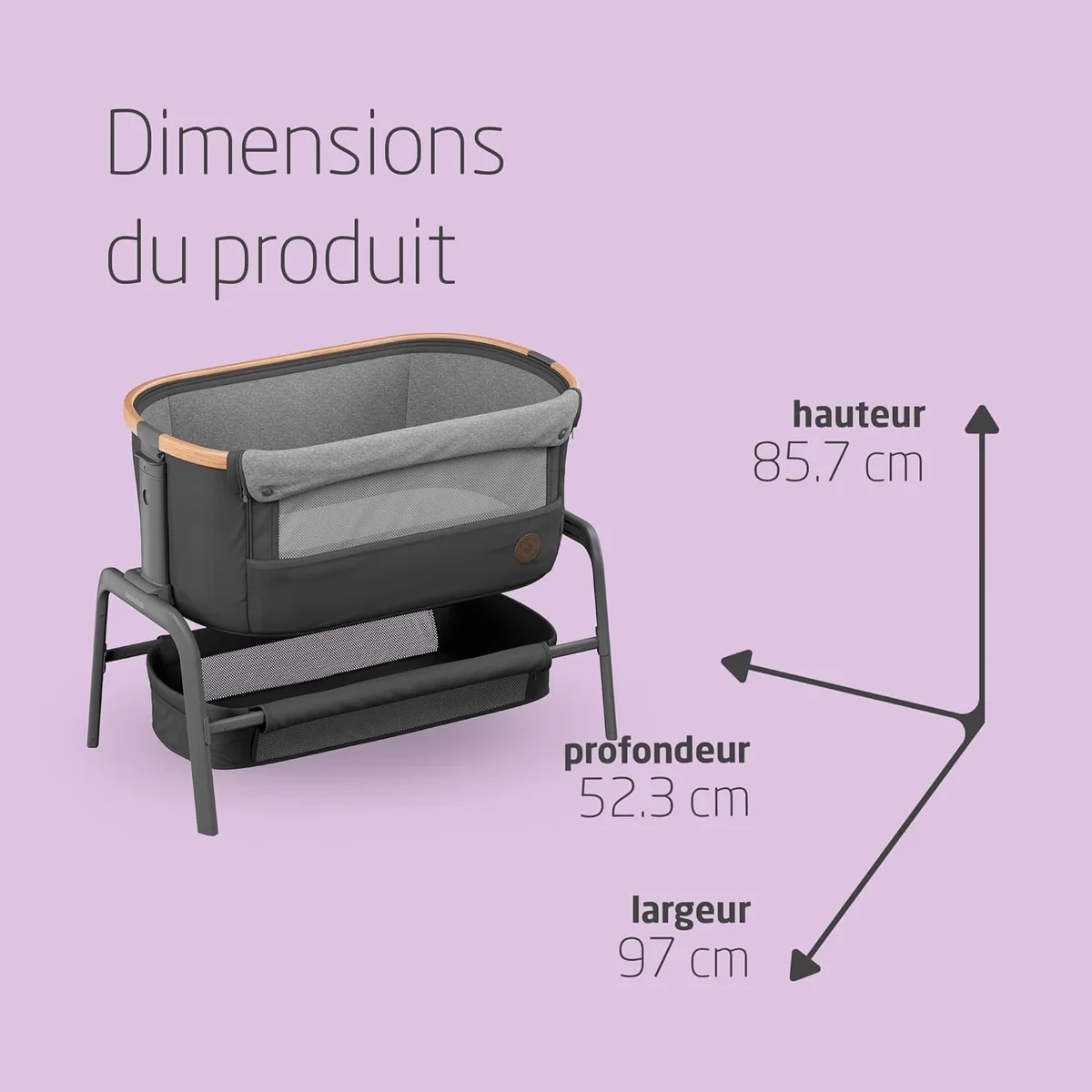
The question of naps
Newborns sleep a lot during the day. Where will they nap? A cot in the bedroom means leaving the living room for every nap, which suits some families and not others. A 2-in-1 bedside crib like the Iora can be used as a standalone crib in the living room, side up, but it has no wheels and weighs 10.8 kg. A Moses basket or light crib reserved for the day is another solution. Whatever the option, the sleeping rules are the same: on the back, flat, nothing in the sleeping space.
With a toddler at home
If you already have a child sleeping in a cot, you may hesitate to move them to a bigger bed to free up their cot for the newborn. A bedside crib avoids rushing that change: the newborn sleeps in the parents’ room for a few months, and the older child keeps their bed. This leaves time to prepare each transition without turning everything upside down at the time of the birth.
And for trips?
If you go away often, the main sleeping space and the travel sleeping space are not necessarily the same. A cot does not travel. A folding bedside crib like the Iora fits into a bag of 107 x 56 x 18.5 cm and can go by car, but it needs a compatible host bed to be used attached, otherwise it is used as a crib. A travel cot is designed for travel and lasts longer. Many families combine a main sleeping space at home and a travel cot for holidays.
Our view
If your bed is compatible and the nights of the first months are your priority, the bedside crib is the most comfortable sleeping space for parents, provided it is set up with no gap and used with safe sleep practices. If your bed is not suitable, or if you prefer a single purchase, a cot set up in your room from birth is a simple, lasting solution. The standard crib sits between the two. None of these choices is better than the others for safety, as long as the sleeping space is compliant and the basic rules are respected.
Points to check, whatever the sleeping space
- A stated standard: EN 1130 for cribs and bedside cribs, the cot standard for a cot.
- Instructions in your language, with the warnings and the age and weight limits.
- A firm mattress, exactly the size of the sleeping space, with no gap at the sides.
- Fitted sheets available in the right size.
- A stable structure, with no damaged parts or protruding screws.
- A location away from windows, radiators and cords.
These points matter as much as the type of sleeping space you choose. A badly equipped cot is no safer than a well set-up bedside crib, and the reverse is true too.
What parents often remember
In the feedback we read, parents who used a bedside crib mostly remember how simple the nights with a newborn were, and the peace of mind of seeing their baby next to them. Those who chose a cot from birth appreciate not having a transition to manage at 4 or 6 months. Both groups agree on one point: what matters is a sleeping space suited to your bedroom, your bed and the way you live your nights.
The choice in one sentence
Compatible bed and easy nights as the priority: the bedside crib. Incompatible bed or wish for a single purchase: the cot in your room. Need for a simple sleeping space you can place anywhere: the standard crib. In every case, your baby sleeps on their back, flat, on a firm mattress, with nothing else in their sleeping space, and preferably in your room for the first six months.
Where does the Maxi-Cosi Iora fit?
The Iora is a 2-in-1 bedside crib: attached to the bed with the side down, a standalone crib with the side up. It therefore covers both the need for closeness at night and the need for a crib for naps, during its few months of use. It does not replace a cot for later. See our Iora review.
Frequently asked questions
Is a bedside crib safer than a crib?
Neither more nor less, if they are compliant and used correctly. A bedside crib also requires a setup with no gap on a compatible bed.
Can you use a cot from birth?
Yes, with the base in the high position for the first months, following the instructions.
Does a bedside crib replace a cot?
No, it only lasts a few months. You will need a cot afterwards.
Can a Moses basket be used at night?
If the manufacturer approves it for that and it is placed on a stable surface. It lasts a very short time.
Ready for those first nights?
2-in-1 bedside crib · 0 to 6 months · Up to 9 kg · Travel bag. Prices and colours change often on Amazon: check them, along with the seller, the exact model (Iora, Iora Air, Iora Plus…) and whether it fits your bed, before ordering.
Check the price on AmazonAffiliate link · new tab